


Source: Mr Bridge
A Multi 2 opening bid shows either a weak hand with a long major or some strong hand. The weak hand with a long major is like a weak two opening, say a 6-card major with 6-10 points. The stronger hand might be balanced or, as some play, eight playing tricks in a minor or possibly a three-suited hand. People play a Multi because doing so frees 2
 and 2
and 2 for another purpose. In the early days of the Multi, the other purpose for 2 and 2 was retaining them as natural Acol two openings.
Nowadays, I suspect the majority of Multi users play 2 and 2 as weak two-suited openings such as ‘Lucas‘. Usually, responder to the Multi 2 opening takes one of three actions:
(i) 2 = to play facing a weak two in hearts.
(ii) 2 = to play facing a weak two in spades but with heart support.
(iii) 2NT = strong enquiry.
After the 2 response, opener passes with a weak hand and hearts, bids 2 with a weak hand and spades, or bids something else with a strong hand. After the 2 response, opener passes with a weak hand and spades, bids 3 or 4 with a weak hand and hearts, or bids something else with a strong hand. After the 2NT response, there is greater variation on the continuations. A possible set of rebids (where a balanced hand is the only strong option) is:
(a) 3 = max weak two in hearts.
(b) 3 = max weak two in spades.
(c) 3 = min weak two in hearts.
(d) 3 = min weak two in spades.
(e) 3NT = strong balanced.
Let us see an example:
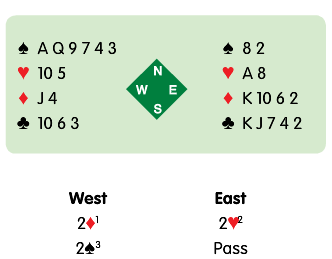
1 Multi
2 Relay, to play facing a weak hand with hearts
3 Showing a weak two in spades
Note that this auction has taken an extra round of bidding compared with a weak 2 opening. As the Multi is a complicated convention, you may well be more interested in how to play against it rather than how to play it. Defending against it is a bit different depending upon whether you are in second seat or fourth seat.
In either case, assuming the Multi bidder has a weak hand, you will be bidding with strength rather than weakness. In second seat, since you do not know what opener’s suit is, you cannot readily make a take-out bid. The upside is that much of the time, you will get a second chance to compete. A simple defence is to play everything apart from double as natural.
A double shows either a balanced hand too weak for a no-trump overcall (say 12-15 points) or a strong hand (19 points or more). Remember, partner does not normally have to bid after the double. Usually, opener will have a long major and will not be passing out 2 doubled. If you are short in one major, you can pass first time and then make a take-out double next time if, as expected, opener turns up with a weak two in your short major. A delayed overcall is generally the same as an immediate overcall but weaker, save that a delayed 2NT overcall shows two suits (minors) rather than a balanced hand.
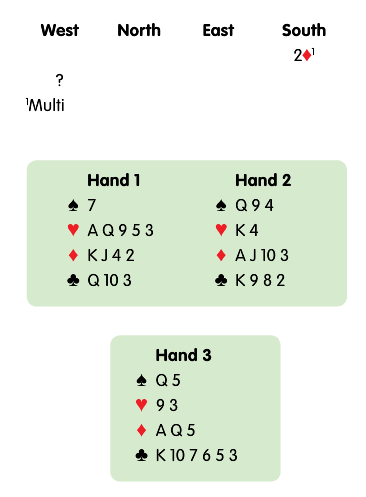
With Hand 1, overcall 2. This will be your last chance to show the suit at the two level.
With Hand 2, double. This shows something like a weak NT (or a very strong hand).
With Hand 3, you are a bit weak for an immediate 3 overcall. Partner will be all too likely to bid 3NT over it and find your hand a disappointment. You should pass first time; you may be able to bid 3 next round to compete the partscore.
In fourth seat, the simplest thing is to treat 2 (Multi)-pass-2 the same as you would treat 2 (weak)-pass-pass and to treat 2 (Multi)-pass-2 the same as you would treat 2 (weak)-pass-pass.