


by August Boehm ACBL Bulletin 2009
An increasingly common carding agreement is to use the trump suit to signal suit preference. Traditionally, if one signaled in trumps, the message was count. High-low showed an odd number of trumps, usually three, and low-high indicated an even number, two or four. Reversing the norm of high-low with a doubleton is sound. If your trumps are 9-2, it might be handy to preserve the 9, just in case there is a chance of an overruff or trump promotion.
The traditional signal is sometimes very helpful when holding three trumps and a ruffing potential. Let’s say that your partner wins the second round of trumps and has seen you play high-low. He knows that you hold a third trump, and, if you confine the signal to suggest ruffing potential rather than routine count, partner may have a useful clue of how to proceed.
Alas, this type of situation is fairly rare. On most deals, the defenders learn the trump count early because declarer draws trump, or the bidding may tell the tale. For defenders, this represents wasted opportunity. Accordingly, you might experiment with suit-preference signals in trumps – here’s the basic model.
Let’s say that spades are trump, and hearts are led, often clarifying the heart position. If your spade holding is 8-5-3, and declarer leads trump, you can choose the order to play your spots. Playing 3-5-8, the lowest card at every opportunity, indicates suit preference for clubs, the lower-ranking side suit. Playing 8-5-3, the highest card each time, advertises diamond preference. Both 5-3-8 and 5-8-3 (middle first) show no emphatic preference. Dedicated partnerships may elect to shade preferences into middle-up-down or middle-down-up.
Be wary, though, of trying to force this signal to do too much. For one, when defenders dither about which card to play, they risk sending unauthorized information. Fast cards are more emphatic than slow ones – players who lead quickly from singletons and slowly from doubletons, beware!
The limitations of the method are evident when holding a doubleton trump. Again, suppose spades are trump and hearts have been led, restricting suit preference to the minors. Your spade holding is 7-4. If you first play the 4 to prefer clubs, or the 7 to prefer diamonds, that’s fine if it matches the message you wish to send. But perhaps you have a no emphatic preference. Then, you’re stuck.
The inherent problem is that you have four possible messages – diamonds, clubs, neither or both and only two signals. The common solution is to use high-low to emphasize diamonds (in this case), and low-high to show either club preference or no preference.
The trump signal can be extended to opening leads. Versus a spade contract, assume that you decide to lead a trump from a low tripleton such as 8-6-2. If you want a heart shift, lead the  8 (high); the 6 (middle) indicates a diamond preference, and the 2 (low) shows clubs, or no preference. Of course, partner (or declarer) may have to see a second or even a third round of trumps before decoding your message, but most spot-card signals share this same characteristic. Which trump do you lead from a doubleton trump against 4?
Following the method, a high trump is emphatic for hearts, low is neutral. Consider this deal: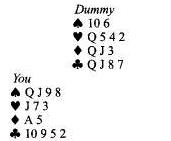
South opens 1 , North responds 1
 , South rebids 3, North raises to 4 and South closes the auction with 5. You lead the Q, partner discourages, and declarer wins the ace. At trick two declarer leads a low trump. How do you plan to defend?
It’s not clear whether dummy poses a threat, which means that you are unsure whether to defend passively (continue spades) or attack. If you switch, which suit will it be? In hopes of obtaining information, duck the first diamond and win the second, noting partner’s contribution. Let’s say that partner follows with the 8, then the 4. Playing suit-preference signals in trump, partner has shown a heart preference, the higher-ranking side suit by playing the trump 8 first. Switch to a heart in case the full deal resembles:
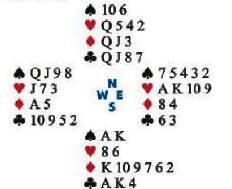
Without a heart switch, declarer can use dummy fourth club for a heart discard, scoring his game.