


Source: Gold Coast Bulletins
Everyone knows that the ace-asking inquiry named after Easley Blackwood is usually initiated by a call of 4NT. We have all had disasters when we wish we had stopped at the four level because partner’s inconvenient response has taken us beyond five of our trump suit. Just as surely, everyone has received a 5 response to key card with hearts as trumps and, not knowing whether partner holds the trump queen (and not being able to ask), been forced to guess. Conclusion: Every established partnership should consider ace-asking inquiries that don’t depend on 4NT and build in a significant number of exceptions to using 4NT as the ace-asking call.
After 1NT and 2NT openings
One of these solutions comes thanks to John Gerber – a man whose convention is probably more frequently misused (on a percentage basis) than Blackwood’s!
A direct call of 4 over 1NT or 2NT is Gerber, leaving 4NT to be a quantitative invitation. The traditional Gerber responses enumerate aces: 4 shows zero aces, 4
 shows one, 4
 shows two and 4NT shows three.
Over a Gerber response, 4NT – if not a response showing three aces – then becomes a sign-off, not Blackwood tell-me-again-how-many-aces-you-have ace asking. Remember, too: When responding to 4, don’t use the Blackwood responses. If you think I’m kidding, I promise you I’m not. I’ve seen a response of 5 to 4 to show two aces more times than you would imagine possible.
Zia Mahmood discusses Pakistani Blackwood, where after a zero response, the next step asks you if you are sure. But we frown on this at our club. Gerber can be enhanced with a qualitative feature. In response to 4 asking, you can use key card-like answers of 4 (one or four aces), 4 (zero or three aces), 4 (two with a minimum) and 4NT (two with a maximum). After the response, whether you use the next step (rolling Gerber) or 5 to ask for kings numerically is up to you.
After Stayman
After Stayman finds a major-suit fit, you have a choice of what slam methods to use. There are two perfectly playable systems that allow responder to show slam interest. I will give you what I consider to be the best (slightly more complex) approach and suggest an alternative at the end of this section.
After Stayman gets a 2 response, 4 can be used as ace asking; there is no obvious other use for the call. 4 and 4 are transfers, suggesting 6–4 in the majors if you play regular Smolen so that 3/ over the 2 response show the 5-4 patterns. A subsequent 4NT becomes key card for the long major and a direct 4NT over 2 remains quantitative.
After a response of 2 or 2, 4NT remains quantitative. Three of the other major shows an unspecified splinter in support of partner’s suit. Partner (the no-trump opener) relays with the next step and you bid singletons ‘naturally’: clubs, diamonds, 3NT being the other major after the 3 ask.
Over the 2/ response, a jump to 4 is key card Gerber; 4 is a balanced slam try with four of partner’s major , and higher jumps are Exclusion Blackwood (discussed later in this series of articles).
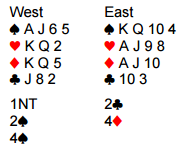 The West hand is an unexciting 16 count that doesn’t become any more exciting when East invites slam by bidding 4 to show a balanced slam-try with four spades.
Imagine, instead, this layout: 1 Four spades, unspecified singleton. 2 Relay. 3 Club shortness.
East shows a slam try with an unspecified singleton and when asked, admits to a singleton club. Now opener can take control – a relatively unusual event in theory — and use keycard. Three key cards and the trump queen make slam easy to bid, whereas 6 has no play if West’s minors are reversed. An alternative approach is to play three of the other major as a balanced hand with at least slam invitational values, and new-suit jumps as splinters. A benefit of the first method is disguising – at least until after the opening lead – dummy’s short suit, if opener is not interested in pursuing slam.
To be continued…