


Remembering a deal from the European Championships of 1956, by Terence Reese (which first appeared in Bridge Today magazine, Sept/Oct 1991 issue).
Who was that? You know the feeling when you see a half familiar image in a mirror as you pass by? Depending on age and sex, it may be a beauteous youth or a crabbed ancient. After a moment you realize it is your-self. I had that sort of feeling when my eye fell on this deal in the defunct magazine, Popular Bridge. The article was by Alfie Sheinwold, an old friend; and I thought to myself, I’ve seen this deal somewhere:
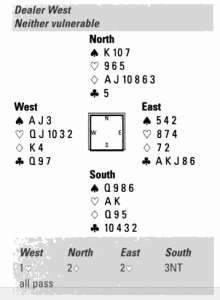
Lead:  Q
Q
Declarer wins the first trick with the K and leads a low spade. West has his finger on the  3, but stops in time to think:
‘Why’s he leading a spade when the contract must depend on diamonds?’
It’s not difficult; he’s trying to snatch a ninth trick. So you go up with the A and switch to clubs. Which club? Normally you would lead the  7, because partner might hold AK10xx and declarer Jxxx. But here you need at least four tricks in clubs, so to prevent any misunderstanding (partner might lead a heart when he gets in) you lay down the queen of clubs and defeat the contract by two tricks.
Yes, it was familiar. Describing the incident from a match between Britain and Finland in the European Championship about thirty-five years ago, Alfie said that I went up with the A and switched to the Q as though they were the two most natural cards anyone could play. Yes I do remember. Today, I expect, I would see it all a moment too late.
Two quite useful lessons emerge:
1. When a declarer in three notrump does not play immediately on his long suit be suspicious — don’t let him snatch his ninth trick while you are resting.
2. When you have decided to play partner for strength in a suit where you hold the Qxx or Kxx clarify the situation by leading the high card. Indeed have my doubts about the standard practice of leading low from such combinations. One bad effect when you lead low from Qxx is that partner, with AJ10xx may make the mistake of winning with the ace, which allows the declarer to hold up his Kxx.