


card Source: The Art of Card Reading at Bridge By Fred L. Karpin
One of the greatest players the world has ever known was the late Helen Sobel, who passed away in 1969. It should be pointed out that in the opinion of her peers she was not thought of simply as the “best woman player,” but rather as one of the best players. Helen, of course, was a counter, for without this asset one cannot rise above mediocrity in ability. In this deal we have an example of her talent of counting out a hand. The hand arose in a high-stake rubber-bridge game at New York City’s Cavendish Club. As was often the case in these high-stake games, a foursome usually contained either two experts or two dubs, or one expert and three dubs. As will be evidenced when the bidding is observed, Helen’s partner, sitting North, was a dub.
Both sides vulnerable North deals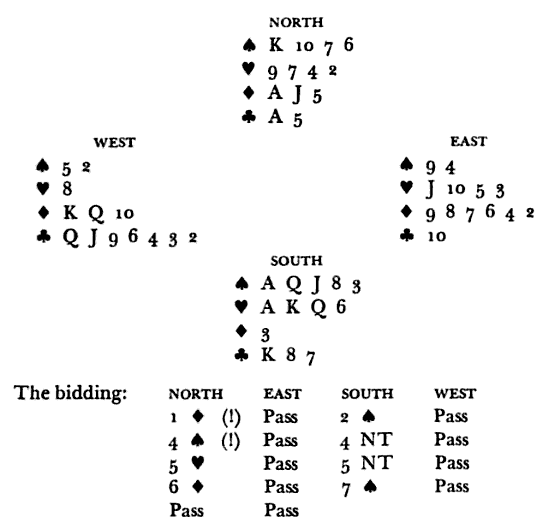
Lead:  Q
Q
North’s bidding defies explanation. His opening one-diamond bid was marginal, at best; and his jump to four spades (rather than three spades) can be justified only if he believed that Helen was a goddess gifted with the ability never to make a wrong deci-sion in either the bidding or the play. Mrs. Sobel’s ultimate bid of seven spades was based on her sense of hearing: she thought that North had a better-than-minimum opening bid (North did jump to four spades). I wasn’t there when the hand was played, but I can easily imagine Helen saying to herself, after North had put his hand down as the dummy:
“What kind of a nut do I have for a partner?”
West’s queen of clubs opening lead was captured by Helen’s king, after which the ace and queen of trumps were cashed, gathering in the outstanding pieces. A diamond was then led to dummy’s ace, and this was followed by another diamond, South ruffing.
Next came a club to the board’s ace. East discarding a diamond. Dummy’s remaining diamond was now ruffed in the closed hand. Mrs. Sobel then stopped to do some counting.
With East having failed to follow suit to the second club lead, West was revealed as the possessor of seven clubs. West had also followed suit to two trump leads and three diamond leads. So he had, at most, one heart. The ace of hearts was then cashed, West dropping the eight-spot as East followed suit with the heart three. Since all of West’s original thirteen cards were now accounted for, East had to have the tripleton J to 5 of hearts remaining in his hand. South’s last club was now ruffed in dummy, after which the four of hearts was led. When East covered with the five-spot, Mrs. Sobel inserted her six, knowing that it would win the trick. When it did, she claimed her contract.
I don’t know what the stake of the game was, but I would imagine that it was somewhere between five and eight cents a point. Since a vulnerable grand slam is worth 1500 points, and a vulnerable game nets one 500 points (both sides vulnerable) , and the trick score for making seven spades is 210 points, the fulfill-ment of the grand slam was worth 22 to points (actually 23 to points, considering that if she had gone down a trick, she would have lost too points) . At the assumed minimum rate of five cents a point, that comes out to $115.50. As I think we will all agree, counting out a hand can be most remunerative—even at a tenth of a cent a point, for a killing of $2.31.