





Part I: An Extract from The Theory of Opening Lead By Krzysztof Martens
High level of opening leading can be achieved solely by means of clear and simple in its forms, logical thinking. H. Kelsey
Opening lead is the least liked part of bridge. This is the consequence of a sad fact that most players lead poorly. And much as we are able to tolerate or even get to like shortcomings of our character, accepting intellectual weaknesses goes against human nature. Hence aversion to defensive play, observable at every stage of bridge development. To be sure, good players lead better than weak players, but the level of opening leading always lags behind declarer play or bidding skills. It is therefore common for many players to treat hands in which they defend with some sort of impatience.
Having gathered all the available data concerning the meaning of the auction we need to focus on two key question, the second of which is a logical consequence of the first. We should:
– Imagine typical hands of declarer and dummy.
– Come up with a hypothesis about how, in general terms, the play will proceed. Such hypothesis may be formulated in the following manner:
– declarer will seek to ruff his second suit in dummy; or
– declarer will intend to draw trumps and establish dummy’s long suit; or
– lacking other options, declarer will be forced to look for honour tricks in all suits; or even
– unfortunately, due to insufficient information we are unable to predict declarer’s plan of play.
– If we are able to at least tentatively determine declarer’s intentions, we will, needless to say, strive to counter them.
Lets see some examples: 
It is very likely that declarer will attempt to ruff spades in dummy. This suggests the trump lead.
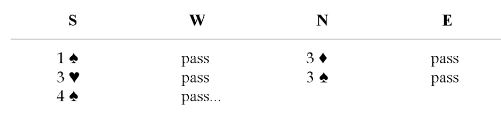
Declarer’s intentions are equally easy to guess. After drawing trumps he will try to use dummy’s long diamonds. The attacking club or even heart lead seems necessary, while the trump lead, apparently handy for declarer, would be a serious error.

Declarer will use all suits as sources of tricks, so we must lead passively.
A vitally important problem is the choice of passive or active defensive strategy. Active defence consists of establishing and cashing one’s tricks. The objective of passive defence is not to let declarer take the declared number of tricks. Both methods share the same purpose. Every time we are on lead we must coinsider whether declarer possesses the sufficient number of tricks. Acting on the hypothesis that he does, we would choose the active defence. It is imperative in such situation to cash our tricks immediately, even if, on the face of it, we are losing something.
Assuming, by contrast, that declarer is short of tricks, we would defend passively, to avoid supporting him with additional tricks. The next step in our opening lead analysis is the estimation of the chances of making the contract. This must include:
- level of the contract;
- type of contract (suit or notrump);
- opponents combined strength;
- characteristics of opponents’ hands (balanced or unbalanced, possession of good long suits etc.);
- favourable or unfavourable – from declarer’s point of view – breaks and location of honours.
The above analysis will allow us to divide all contracts into four groups:
light, where combined strength of the opponents is below the average strength required for the contract of the given level. Such contracts, unless totally hopeless, are based on some compensating features of opponents’ hands
- with sufficient strength;
- with combined strength above the average required;
- with unspecified combined strength.

Clearly, this contract lacks sufficient HCP.

Here the combined strength more or less corresponds with the level and type of the contract.
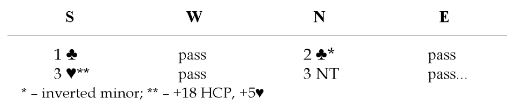
Plenty of extra strength, at least 29 HCP between the opponents.

The combined strength is not specified, falling somewhere between 23 and 31 HCP.
Classifying the contract as belonging to one of the above categories has significant bearing on the strategy of the opening lead. This is because:
- light contracts are usually fulfilled only with favourable layouts;
- contracts with adequate strength require at least average layouts;
- contracts with extra strength can only be defeated if the layout is evidently unfavourable for declarer.
Finally, in considering the opening lead we must take into account our actual hand. Here we must first of all look at the HCP distribution to determine our partner’s potential.
(40 HCP) – (opponents’ combined strength, from-to) – (our strength, from-to) = (partner’s strength, from-to).
Generally speaking, the stronger our hand is and weaker partner’s, the more advisable it is to lead safely, passively. Conversely, being much weaker than partner, we can lead boldly, actively.
In selecting the suit of the opening lead it is necessary to take into consideration the probability of establishing or losing a trick (or tricks) in the suit. Importantly, it should also be assessed if possible loss of trick will affect the outcome of the hand. There are hands where the number of tricks that can be taken by both sides exceeds thirteen.
Before moving to specific examples, let us summarize factors involved in choosing the opening lead.
- Bidding analysis, making use of all available clues (including negative ones).
- Painting the picture of dummy’s and declarer’s hand.
- Anticipating declarer’s plan and, accordingly, defining our own objectives.
- Assessment of the chances of making the contract in view of the favourable or unfavourable breaks and location of honours.
- Determining the strength of all four hands and, as a consequence, our chances of establishing or losing a trick in the suit we are contemplating leading.
The conclusions drawn from all these considerations will be, as a matter of practice, utilized selectively – in some cases only some of them will be of real significance. For example, in a hand where opponents reach their contract after an extremely intricate auction, abounding in detailed information about their shape, distribution of honours etc., we will be more concerned with points 1, 2 and 3 above. lf, by contrast, the bidding was short and not too revealing, we will pay more attention to points 4 and 5, acknowledging the first three with only a short statement, resulting more from our experience than from analysis.