It’s not enough to play well by Susanna Gross

The spectatorSusanna Gross 8 November 2014

To get good results at bridge, it’s not enough to play well — your opponents need to play badly; and if they won’t oblige, you’ll need to help them along. Some players do this the unethical way: they try to intimidate their opponents with officious behaviour, or else create a whirlwind of jollity designed to shatter their concentration.

One player I know — I’m tempted to name him but I won’t — always manages to make the sort of cutting remark that leaves his victim unable to dwell on anything for the next hour. He once walked behind me before a match was about to start and paused to say, ‘Ooh, you’ve got a small bald patch.’

Martin Hoffman
Martin Hoffman

But none of this shoddy behaviour is necessary: there are legitimate ways of prompting opponents to make mistakes through the art of deception, and how much more satisfying they are. Getting them to cover an honour when they shouldn’t, for instance, or duck the setting trick, or lead the wrong suit… And here’s a wonderful new trick I learned the other day from the great Martin Hoffman:Mano Gross
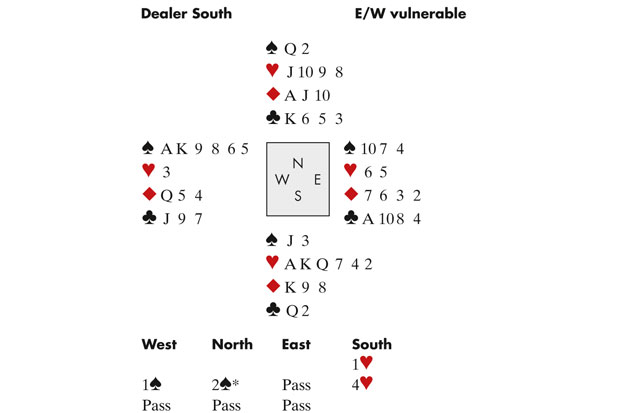
West led the ace and king of spades and switched to a trump. If you guess which way to finesse diamonds you have ten tricks.

But there are other chances: play low towards the Q: if East holds the A and hops up with it, you will score two clubs (and can pitch a diamond from hand).

But East played low and the Q won the trick. There are other legitimate chances: you can hope East started with Ax (highly unlikely), or Axx, in which case you can duck a club and then ruff one, bringing down the A. None of it works. But Hoffman did something I would never have thought of: after winning the Q he crossed back to dummy with a trump and led a club towards the 2!

This time East did hop up with the A, fearing Hoffman had the J. A perfect con — and done in the nicest possible way.

MAS DEL MISMO AUTOR

BOLS Bridge Tip: Fear the Worst

When opponents bid unexpectedly high, ask yourself if your hand contains any nasty surprises. Photo: Marcelo Lerner, Terence Reese, Eduardo Berisso y Boris Schapiro en el Campeonato Mundial de Bridge, Buenos Aires 1965

Strip-and-End play

To decide your plan of play in any deal, follow the order of choice of plays. Somewhere in that list will be the play you need to make the contract you are after.

The Exclusion Key-Card Blackwood by Omar Sharif

There are several ways to show a void when responding to Blackwood. But how can the ace-asker request responder to suppress the ace in a suit in which the asker holds a void?

Negative Thinking at Match Points by Jeff Rubens

The answer to the question "What are we doing wrong?" is that we are too positive-oriented. When faced with a critical situation, we too often wonder...Photo: Jeff Rubens, right, accepts his plaque as a new member of the Hall of Fame from Larry Cohen, who handled the introduction.

The Vanishing Loser By Omar Sharif

Be careful about suggesting a line of play when you are given a hand with low cards denoted by an 'x'. As this hand shows, those spots can be deceiving.

Franck Riehm elected as WBF President

The World Bridge Federation is pleased to announce the...

1st South American Online Mixed Teams Championship

All players belonging to any NBO affiliated to the WBF are welcome!

I Brazilian Online Bridge Festival 2020

Some of the best players in the world are Brazilians, and some of the most enthusiastic players too! Our Brazilian Online Festival has appeal to players of all levels. Your team will play in a friendly but competitive atmosphere, with very well-organized scoring and experienced Directors to ensure a pleasant experience for all.

WBF Robot Tournaments

Come and join the competition through our Providers, BBO, Funbridge and Ourgame, all offering you this great opportunity – we look forward to some challenging tournaments!”

The Endplay

An endplay (also throw-in), in bridge, is a tactical play where a defender is put on lead at a strategic moment, and then has to make a play that loses one or more tricks.

The Scissors Coup by John Brown

Scissors coup (or, Scissor coup, ) is a type of coup in bridge, so named because it cuts communications between defenders.

World Bridge Federation – Youth

The Championship is open to all players born on or after 1st January 1992 (Juniors & Girls) or born on or after 1st January 1997 (Youngsters) or born on or after 1st January 2002 (Kids) in good standing with their own NBOs.

Prevent a Ruff by Jon Brown

West led his singleton club, which dummy's king won. South read the lead as a singleton.

RELACIONADOS

CATEGORIAS POPULARES