




Source: Master Play in Contract Bridge By Terence Reese
“There was no way in which I could tell.” How often is it true?
Early in the play, not often ; towards the end, never.
Players who throw the wrong card after ten or eleven tricks, then make this excuse, are simply confessing that they have missed some inference or been misled by their partners, for there must always be an indication of some sort. This article is concerned, not with any form of technical play, but with the process of reasoning that will lead a player to the right choice when he seems to be faced with a dilemma. Mostly, this is a defensive problem. A defender who has to make a critical play should tentatively select what seems the best line and then examine it in the light of the following test:
1. Is there anything in my partner’s play up to now that does not fit in with the picture of the hand on which my intended play is based?
2. Is there anything in the declarer’s play that does not fit in with my general picture?
3. Have I counted the declarer’s possible tricks and am I satisfied that the play I have in mind, in so far as it contains any risk, must be made now?
There are few problems that cannot be resolved by a player who will direct his mind to each of the three questions above. In the first example West finds the answer by applying test no. 1. The full hand is shown, but the conscientious reader will study the situation as it appears to West when he has the lead at the fourth trick.
South played in 4 , having supported North’s hearts on the way. West opened
  5 and the ace won. East played
  K, then 7, on which South false-carded the 6, then 8. West won and had to decide whether to try to cash a third diamond or the K.
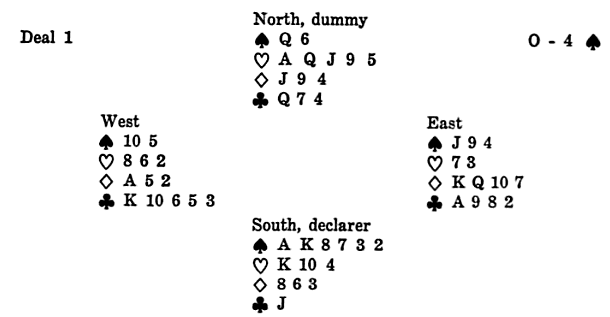
“South might well have dropped the jack of clubs from J-x,” West thought to himself. “I couldn’t bear it if he were to ruff a third diamond and discard a club on dummy’s hearts. It’s a guess, no one can blame me if I do the wrong thing.”
So West tried to cash K and the contract was made. With all the evidence before you, can you say how West should have known which suit to play?
No sure inference could be drawn from the bidding or from declarer’s play: South’s shape could have been 6-3-2-2. But what of East? Suppose that he had held K-Q-10-x-x : would his defence have been the same?
In that case East would have known that the defence could take only two diamond tricks. It would have been his clear duty, after making K, to cash Q, intending to hold the lead and switch to clubs. Once a player directs his mind to the problem, this is not a difficult inference to draw.
Players make mistakes because they do not begin to think along the right lines. A universal example occurs when the right-hand defender, East, fails to lead up to obvious weakness in the dummy. The immediate inference should be that he has a high card of the suit, ace or king, and can stand a lead from his partner.