




Source: September 2016 ACBL Bridge Bulletin 


In the same vein as last article, I present you with a bidding sequence and three possible hands you might hold. Your job is to grade the three hands from best to worst, then decide what call to make with each. Because the bidding sequence includes interference from the opponents, you are in a position to upgrade or downgrade your hand. Before committing to a contract, anticipate how the play will proceed. Remember that a hand’s value is apt to fluctuate as the auction develops.
Matchpoints, neither vulnerable:

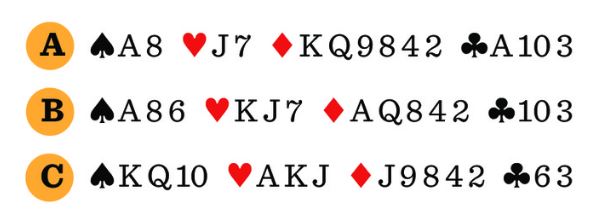 All three hands contain 14 HCP and at least one spade stopper, but their worth is very different. The best hand is A, because it contains a decent fit for partner’s long suit, plus a source of fast tricks in diamonds if partner holds the ace. On A, I think 3NT is your best move. Yes, the hearts are wide open but you cover the main threat, spades. If you don’t bid 3NT, how can you expect partner to do it for you if he holds two low spades and suitable minor-suit honors? It’s your gamble to take, and the risk of missing 3NT seems greater than the danger of going set.
The next best hand is C, more oriented to defense than offense. You have a double spade stopper but consider how the play will progress if partner holds something like:

Unless you find a very lucky lie in clubs, K-Q-(x) onside, you must lose the lead twice before establishing your longest suit. Meanwhile, the defense is plugging away at spades and establish-es three spade tricks, two clubs, and at least one diamond. 3NT is typically a race, and on deals like this, declarer’s tricks are too slow.
I think double is the best call with C. Sensibly, it is not pure penalty because you are doubling a raised suit in front of the length. It may be old school, but I think double should show spade values plus a clear interest in defending if partner has a hand like the one shown above, where 3 doubled is probably going down a few with no game your way. If partner has an unexpected trick source in clubs, he can remove the double to 3NT. Holding: partner can be confident that your double indicates spade values.
The worst hand is B because it has neither a ready source of tricks nor extra defense. When you have noth-ing to say in a competitive auction, the appropriate call is pass. Partner knows your side holds the balance of power and is there to balance; whatever he does is acceptable. If he bids 4 or 4 , you have found a fit and should probably pass – there are many losers and partner could have bid a minor-suit game with extras. If partner doubles, you have a new prob-lem worthy of a bidding panel; either bid 3NT or pass for penalty. If partner’s double shows an inclination to defend, I’d pass and take a likely plus score rather than speculate on 3NT without fast tricks.
The main point is that a pass in the direct seat of a competitive auction is expressive – it implies a neutral stance, a hand that is equally well suited to declaring or defending. Hand A was offensive in nature, hand C was defensive. In each case, you acted in the direct seat to express a strong opinion. If you hold a hand without a clear orientation like B, let partner decide. When in doubt, allow partner to share the decision.