




Source: April 2016 ACBL Bridge Bulletin 


As this series of articles is intended to demonstrate, there is a lot more to hand evaluation than simply counting your points. In particular, when you face a distributional partner, don’t count high-card points in bulk. It leads to much less accurate hand evaluation than weighing the location of your honor cards. There are many conventions that announce specific two-suited hands, e.g., Michaels, unusual notrump, Landy, etc. To put these conventions to best use, responder should promote secondary honors inside partner’s two suits and aces outside. The acid test is to compare different types of respond-ing hands and visualize how well they play facing a typical two-suiter.
For instance, assume that partner announces a major two-suiter and holds:
 Of the two responding hands below, which is more powerful?
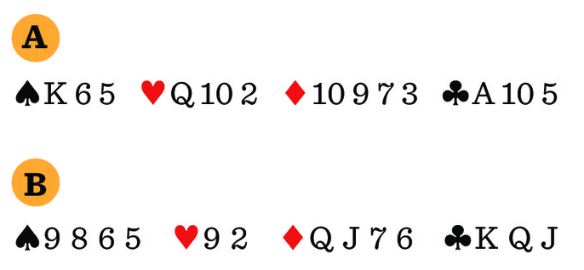
Hands A and B both contain 9 HCP, but that’s where the similarity ends. Hand A provides a good play for 4 while Hand B may not make 2 . In A, both the secondary honor cards are working hard, filling partner’s long suits, covering losers. In B, quite possibly all the honor cards are useless. Facing a singleton, the A is far more valuable than the K-Q-J. If the auction started 1 by LHO, 2 (Michaels) from partner, Hand A is worth a game bid. To offer partner a choice of majors, a cuebid of 3 seems in order. On Hand B, compete no higher than 2. Your concentration of honors in the minors strongly suggests defending. It may seem odd that the value of an ace sometimes depends on location, but consider the next two-suiter:

. Facing this minor two-suiter, which hand is preferable?

Hand C rates to have four to five losers in a minor suit fit. Even if the minor suit aces are onside, if they aren’t also doubleton, there are insufficient entries to continue to lead towards the strength. Hand D has only three losers on normal 3-2 splits.
There is a useful moral: downgrade hands with low values in partner’s two long suits. If the auction began 1 on your left, 2NT by partner, sign off at the three level with Hand C. Hand D is worth a push to the four level. The aces that mesh with partner’s length are obviously good for offense, and they also diminish the overall defensive po-tential. On D, some of the partnership’s honor cards are wasted on defense because eventually they will be trumped.
Let’s say you are dealt:

. Both vulnerable, LHO opens l , partner intervenes with 2 (Michaels showing the majors), and RHO jumps to 3NT. Do you act? Forget HCP and think tricks. First of all, do you have helpful values in partner’s two long suits? Absolutely! Four decent trumps and a singleton ace is a potent combination.
A vulnerable partner is expected to be robust; project the play facing this:

Versus normal distributions, your losers in a spade contract are one spade and three tricks in the minors, down one. Meanwhile, the opponents are cold for 3NT with two running minors. In fact, if they bid5 over 4, suggesting extra distribution, it is likely right to sacrifice in 5 – down two doubled costs 500 instead of paying out 600. Conventions that announce specific two-suiters can be very productive because they unleash a responder who recognizes meshing values.