




Source: Bridge Conventions in Depth By Matthew Granovetter, Pamela Granovetter
Agreeing to open four-card majors is not really a convention, and indeed, it was once the norm. Today, however, it is unusual, although many experts play four-card majors frequently, including Bob Hamman, Eddie Kantar, and Paul Soloway, among others. However, even five-card major players often open with four-baggers opposite a passed partner to avoid this kind of bidding accident:
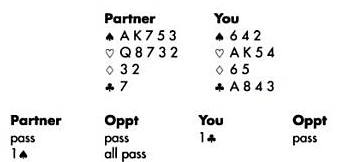
Playing four-card majors, you open 1 instead and your partner forces to game. Without four-card majors, you are forced to bid again as a third-seat opener with the above hand in case there’s a heart fit; now partner will think you have a full opening bid and you will often get too high:
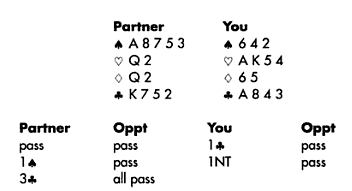
This auction shows what happens if you open light in a minor suit and take another hid –you get overboard. Had you opened with 1, the bidding would have gone:

If the opponents want to push you up to the two-level, that’s fine; and if the opponents push themselves up to the three-level, you can double them. The idea of the light third-seat four-card major is that you plan to make only one bid, but if you hit partner with a big distributional fit, you can also reach game. The four-card majors opposite a passed hand rule is:
[box]If you are going to open the bidding in third or fourth seat with a light hand, and you are not going to take a second bid voluntarily, open with your four-card major.[/box]
The benefit of this agreement is that you can still reach game when it’s there, which, after all, is the biggest bonus for opening the bidding. A further benefit is that your major-suit opening bid makes it more difficult for the opponents to get into the bidding. For example, after you open 1 , they can bid anything they like at the one-level, but after you open 1
 , they have to bid at the two-level, which requires a stronger hand or involves taking more risk.
If you play modified Drury, you can show partner whether you opened on a four-card or five-card suit, and he can show you if he’s got three- or four-card support. By the way, the four-card major opening also works perfectly with forcing notrump responses, because you simply pass the forcing notrump.
A Useful Adjunt
Suppose you have 1-5-4-3 shape and a light hand. You open 1 in third or fourth seat and partner responds with l. What are you going to do? If you bid again, your partner will think you have a full opening bid and you’ll get too high. On the other hand, you can hardly pass and leave partner in a possible four-one fit. The answer is: open with two hearts in third seat!
Here are two example deals:

North-South reached game because North opened a four-card major in fourth seat. In this case, North can pass a one-spade response. Had North opened one diamond and South bid one heart, North would have had the unhappy choice of taking a second bid with a minimum, or failing to raise with excellent support, thereby possibly missing a game. Since the money is in the majors and not the minors, North can get the hand off his chest with a one-heart opening bid and then call it a day.
Is 4 a good game? If hearts are 2-2, it’s cold. If not, there are many chances: a friendly spade situation or opening lead (East actually led the 6, picking up the suit for declarer), the  Q falling third, the opponents being unable to play trumps three times, or, if all else fails, a misdefense.

This time the four-card major bid created a game swing out of thin air.