


Source: www.pittsburghbridge.org
Either I am getting a little rigid or my bidding is so bad that I can’t afford the luxury of exotic conventions to take care of hands that rarely come up during a session. However, the chance to expand on the treatment of a familiar cornerstone convention is quite intriguing. The Stayman convention over one no-trump is a prime example of constructive improvement in scope which accomplishes a great deal more than its primary intention of finding a 4-4 major suit fit.
Before you dismiss this idea, ask yourself some of the following questions. Have the opponents to often found the killing lead against your 1NT-3NT gambler? Do you miss your 4-4 minor suit slams and end up playing in bad 3NT contracts? Or worse, do you go down when a minor suit partial is marked? Do you miss games because you are afraid of incorrectly describing a hand with 15 to 17 points and a six card minor by opening 1NT? Do your 4-4 major suit fits frequently take as many or less than if the hand played in no-trump? In general, has your judgment been somewhat less than adequate after partner has opened one no-trump?
Without altering any of the primary meanings of the Stayman sequences, we should be able to handle minor suit slam tries which depend on finding 4-4 fits. Some of the hands referred to are shown below as examples. How would you handle the following hands if you were responding to a 1NT opening by partner?
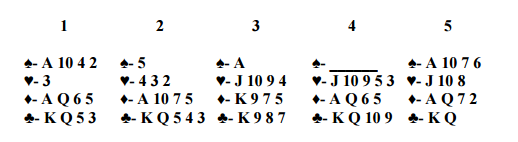
Hand 1 and 4 will probably produce a minor suit slam if a 4-4 minor suit is found but each can play at other contracts. Hands 1 and 5 could be played at either a spade or a diamond slam if a 4-4 fit is found. If no such fit exists then a 3NT contract may be tried. In order to facilitate exploration of minor suits over 1NT bids, I propose a 2 club response followed by 3 clubs as an extended Stayman asking for other suit information. Let us take a look at some sequences and their meanings.
| 1. | 15-17 Points | 1NT | 2 |
Bid four card major |
| No major | 2 |
3 |
Bid four card minor | |
| Suit is diamonds | 3 |
3 |
I like dia, Spade control | |
| Club control | 4 |
4NT | keycards (diamonds) | |
| 1 or 4 controls | 5 |
6 |
Slam in diamonds | |
| 2. | 15-17 Points | 1NT | 2 |
Bid a four card major |
| Have 4 spades | 2 |
3 |
Bid other four card suit | |
| No other | 3 |
3NT | To play | |
| 3. | 15-17 Points | 1NT | 2 |
Bid four card major |
| Have 4 spades | 2 |
3 |
Bid other four card suit | |
| Have 4 hearts | 3 |
4 |
To play | |
| 4. | 15-17 Points | 1NT | 2 thru 2NT |
Four suit transfers |
| 5. | 15-17 Points | 1NT | 2 |
Bid four card major |
| Have 4 hearts | 2 |
2NT | Invites game | |
| 6. | 15-17 Points | 1NT | 2 |
Bid four card major |
| No major | 2 |
3 |
5 hearts, 4 spades (Smolen) | |
| 7. | 15-17 Points | 1NT | 3 |
5-5 Minors (Weak) |
| Fit Clubs & minim | Pass | Pass | To play | |
| 8. | 15-17 Points | 1NT | 2 |
Bid four card major |
| No major | 2 |
3 |
Bid four card minor | |
| I have clubs | 3NT | 4 |
Fit clubs Kick back keycard for clubs | |
| 9. | 15-17 Points | 1NT | 3 |
5-5 Minors (Strong) |
| Max heart control | 3 |
4 |
Spade control | |
| 6 |
Pass | To play |
Over interference we like to use cue bids to ask for major suits. We also use Lebensohl logic where possible. Since all transfers are off when opponents are in the auction, all bids at the 2 level are to play and all 3 level bids are game forcing. 2NT by responder forces 3 and any bid less than opponent’s suit is non-forcing while any other bid is game forcing showing stopper in opponent’s suit. There can be more bidding combinations starting with the Stayman 2 asking bid but agreements should be discussed with partner so that standard implementation and understanding can be maintained. Here is an example that was tried in a club game. Perhaps transferring to spades might have been preferable.
| 10. | 15-17 Points | 1NT | 2 |
Bid four card major |
| No Major | 2 |
3 |
bid three card major | |
| 3 |
3NT | Only two hearts or 5242 distribucion |
This is a system that should be used with a firm partnership. It is quite useful and I am sure many more sequences not discussed in this article may be discovered.