


Fuente: Poor Bridge
What are the elements that make a perfect Poor Bridge? This is a question often pondered here at Durham University.
Well, there are certainly the three key ingredients of poor bidding, poor declarer play and poor defence. Unjustified doubles are always welcome, of course, particularly when it turns out that the contract should in fact go off, but then makes on sub-optimal defence. So what would you say to a board on which two DIFFERENT non-making games are let through, one of them doubled and the other redoubled? And on which declarer, given the chance to make his redoubled contract, fails to take it, only to be redeemed by more poor defence? That would be close to Poor Bridge perfection!
Well, here is a hand from the Durham B – Leeds B match, in the 2nd round of the Portland Bowl:
Board 16
 A 7 3 A 7 3 |
||
 10 6 5 3 10 6 5 3 |
||
 K J 5 4 2 K J 5 4 2 |
||
 J J |
||
| 9 2 |
K |
|
| A Q 7 |
J 8 4 |
|
| A 8 6 |
Q 10 9 7 |
|
| Q 8 7 4 2 |
A K 9 6 5 |
|
| Q J 10 8 6 5 4 |
||
| K 9 2 |
||
| 3 |
||
| 10 5 |
With 25 points between them, E-W are always going to bid game – either 5 or 3NT (despite the spade weakness). In the open room, Leeds bid 5 after East had made a non-forcing 2 raise of West’s 1 opening. Unimpressed by this bidding, Rob (North) doubled the contract.
This was the auction:
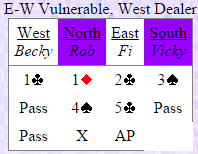
Now this seems to have one loser in each suit outside trumps, but nevertheless it made. The facts of the play were lost in the recriminations due to the bidding, but by playing diamonds through North, ruffing a spade, and finessing in hearts, declarer can find eleven tricks, holding the defenders to just the A and theK.
5X making 11 tricks non-vulnerable: +750. A good score for Leeds?
Well, this was what happened at the other table:
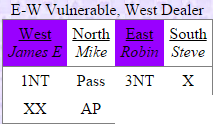
This auction raises the instructive question: when should you double a freely bid 3NT? Assuming the opponents aren’t idiots (dangerous in this sort of match, I know), you’re not going to have a hand bursting with high cards. You might find a double with a good 5-card or longer suit plus one or more likely entries. Then you hope to set up the suit and come in later to cash it. This, of course, assumes that you’re on lead. If you’re not, as South isn’t here, then your partner is unlikely to find the right lead. This is why many good pairs have an agreement that such a double of 3NT shows a good suit and asks partner to try to find it on lead.
In any case, this particular South hand clearly doesn’t qualify. He admitted after the hand that the double was ‘risky’. Well, yes: if his partner has one of the top two honours in spades, finds the spade lead, AND the ace of hearts is under the king, then there’s a risk that the contract goes off. In almost any other circumstance, it makes. So poorness strikes in the auction.
James, clearly fired with adrenaline from his first taste of competitive bridge, and possibly realising that North is not awake enough to try to find his partner’s suit, reaches for the blue card. Three fairly apprehensive passes later, and the play unfolds.
Of course, the lead of the ace of spades would see the defence immediately cash out for 3 off (and +1600!), but you’d have to be clairvoyant to find that. However, even a passive heart or club lead leaves declarer a trick short – he has only 5 clubs, 1 diamond and 2 hearts, via the finesse, before having to give up the lead, after which even the sleepiest defence will surely be able to run the spades. But “4th highest of your longest and strongest” comes to declarer’s rescue – the lead is the 4 of diamonds! The Rule of 11 guarantees that the 7 of diamonds will hold the first trick (it hardly seems worth preserving the beer card), after which the clubs are cashed, ending in dummy.
Of course, declarer can’t be sure that the king of hearts is onside (although North has already shown up with the top diamonds, and South must have doubled on something), but there is no other hope of making the contract. This is the last possible chance to take it as well. So it is with a sinking heart that I now play a diamond from dummy, as instructed – a piece of poor declarer play which should cost the contract. But wait! South, determined to hang on to as many spades as possible, has thrown BOTH his little hearts on the run of the clubs. The ace of hearts drops the now bare king, the queen and jack are cashed, and the result is a scarcely believable 3NT redoubled plus one, for +1400. A great result for Durham, and an even better one for connoisseurs of Poor Bridge.