




Source: info.ecatsbridge.com
My candidate for best defense of 1998 is a misdefense. Yes, you read correctly: a misdefense. Now how could a mistake be the best play of the year? Well, in this case the defender led the wrong suit — that was his error. But he made up for it by leading back the right card (indeed, a brilliant card) in the wrong suit. Take a look:
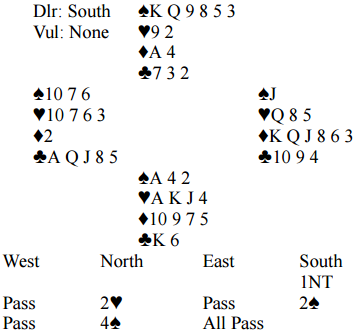
Opening lead:  2
2
This is board 107, the first board of the final set of the 1998 U.S. Team Trials to choose one of the two U.S. teams for the 1999 Bermuda Bowl. At this point in the match, the Nickell team (Nick Nickell, Dick Freeman, Jeff Meckstroth, Eric Rodwell, Bob Hamman, and Paul Soloway) led by a score of 233 to 199 over the Cayne team (James Cayne, Chuck Burger, Mike Passell, Michael Seamon, Larry Cohen and David Berkowitz). With 15 deals to play, 34 IMPs was a huge margin to make up but this deal was worth 10 imps to the Cayne team, who eventually lost by 12.

After a transfer sequence, South reached 4 and West led his singleton diamond. Meckstroth, one of the best declarers in the world, made a slip when he ducked the first trick. This is such a common strategy among the top players that it seemed unnatural to win the ace at trick one. At the other table, however, declarer did win the ace and immediately led a club to his king. He could not go down, with one of dummy’s clubs ruffed in the closed hand.
At this table, Burger won the first trick with the East hand. Now the winning move was to return a high diamond, a suit-preference signal. West could ruff the diamond and exit with a heart or a spade, eventually scoring two club tricks to set the contract. Burger, however, didn’t know that his partner had led a singleton — perhaps South had ducked the first trick with a doubleton diamond to cut communications early. In any case, Burger decided the right suit to shift to was clubs. He was wrong, but he chose the right card. He led back the 4.
Examine the situation. If he leads back the 10 (there’s probably not one in a hundred players who would even think about playing back any card but the 10), what happens? Declarer plays the king and West wins the ace. West now must guess: Did partner start with 10-4 doubleton or 10-9? If partner started with 10-4 doubleton, West must cash two more club tricks (or underlead the third round of clubs for partner to ruff and return a diamond, defeating the contract two tricks). In real life, West would almost surely go wrong on the return of the 10, because Burger-Cayne use frequent count plays on defense, so the switch to a 10 tends to show a doubleton.
Burger’s actual  4 shift relieved partner of the problem and gave him the opportunity to make a nice play in return. South put up the K on the 4 (yes, he could have played low and made the contract, but how was he to know?). Cayne captured the king with his ace and led back the 5. He knew from the 4-spot that partner held three clubs, and his only hope was that partner held the 10 as an entry. Burger won the 9 at trick three and realized by now that a diamond ruff was available. So he returned a diamond to set the contract (better late than never).
A final thought: Edgar Kaplan once wrote that Norman was a very considerate partner because in a similar situation, when Edgar had underled a string of honors to find his partner with the 10, Norman with the 10-9 won the trick with the TEN so as not to cause the least bit of stress on Edgar (who would have to wait for South to follow if Norman had played the 9).