





Source: www.qldbridge.com Bulletin Oct-Nov 2015 by George Cuppaidge 


SOME spots in bridge are notoriously worse than others. 2NT is particularly bad one. If you go one down you have overbid, if you make an overtrick you have missed game. To score well you must make on the knocker. Playing in five of a major is similarly notorious. So?
You should agree never to play there. Play 2NT as forcing, always, as Tim Seres did. This will help you to solve a myriad of bidding problems while at the same time freeing up your suit bids as natural. 2NT works just as effectively as “check-back” as do 2 or new minor forcing and those bids become free again as natural. So often two of that minor is as far as you want to go. As well, when partner raises your new minor, you know he has extra values and is not simply obeying your command. After 1-1; 1NT, you can make the bid you want to make, 2, holding:
Q9654 32 AJ753 6
For completeness, it should be noted that the 2NT opening bid, when played as 20-22 balanced or some similar range is not forcing but all other instances of 2NT are, including 2-2; 2NT. It is used to find the best game or slam, often not 3NT. Unless the context says otherwise, 2NT creates a gameforce. It is never a game invitation.
These examples demonstrate this use of 2NT in solving bidding problems at both extremes of distribution. Perhaps they are “obvious” without any agreement, but to have this agreement makes life a whole lot safer.
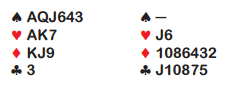
This is how the bidding went. It was on BBO of course.
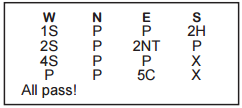
Would you, dear reader, have come to the same conclusion that this West did? That partner had found a couple of aces? This is not a common situation. It is so often right to give up if you are staring at a misfit, but it is nice to be able to improve the contract in safety when you have a hand like this. This use of 2NT much reduces the risk.
It is always a good idea in bidding to stop and think when partner has made an unusual bid. Ask yourself just what it might mean, and weigh up before bidding on. This particular West appears to have missed two such opportunities. His actions are of a common variety, thinking only in terms of his own cards:
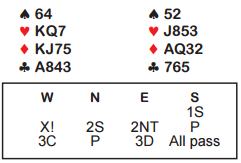
Many players would see 3 as automatic on the East cards at his first turn, relying upon partner’s double of 1 to promise four hearts. To be fettered by such an agreement means that West has no bid on a good hand such as this one. This particular use of 2NT permits EW to do the best they can in this typically tense tactical situation. Over 2, East is too good to pass and not strong enough to insist on game. You have shifted the problem to NS. Do they double you for one down? Or do they take the push? They certainly can make 2. Not vulnerable, if 2 is their limit you have out bid them whatever they do.
Important to note is that since 2NT is forcing, East can bid it with a stronger hand. He might use it with four cards in hearts and a stopper for example. With extra values, West must make sure game is reached. West’s cue bid in reply to 2NT shows a three-suiter. If East bids 2NT and corrects 3 or 3 to 3NT he has four hearts and at least half a stopper.