





Source: Mr. Bridge
What is false preference?
False preference is when partner bids two suits and you return to the first suit even though you have a card more in his second suit.
When can false preference occur?
False preference can occur in a variety of situations when partner has bid two suits. The most common situation is when partner opens a suit, you respond in a new suit or with 1NT, and partner rebids in another suit. For simplicity, all the examples I shall give will be from this most common situation.
What is the purpose of giving false preference? There are two main purposes:
1. To improve the contract.
2. To keep the bidding open.
How can giving false preference improve the contract?
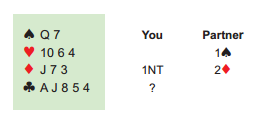
There are three likely lengths for partner in spades and diamonds: 5-4, 6-4 and 5- 5. Facing the 5-4 shape, your choice is between playing in the 5-2 spade fit and the 4-3 diamond fit. You will usually find a 5-2 fit easier to play than a 4-3 fit because you can ruff something in the long hand and still have as many trumps as the defender with the longer holding. Facing the 6-4 shape, it is clearly better to play in the 6-2 fit for a combined total of eight trumps than in a 4-3 fit with only seven. Only when partner is 5-5 has your preference made the contract worse.
Are you still not convinced? Consult a table of probabilities. You will find that a 5-4-2-2 shape and a 5-4-3-1 shape occur on about 23% of hands. A 6-4-2-1 and a 6-4-3-0 shape occur on 6% of hands while 5-5-2-1 and 5-5-3-0 shapes occur on only 5% of hands.
Why would you want to keep the bidding open?
Even if partner has made a non-forcing rebid, you might still have game on if you have 8-10 points. For a jump rebid in a new suit partner will usually have 19 points upwards. This means that a simple rebid in a new suit might contain as many as 18 points. Obviously 18 points is unusual. However, 16-17 or a good 15 is quite common.
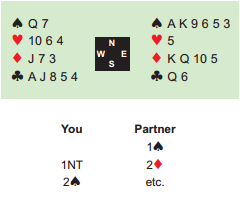 You would hardly expect your partner to bid 3
 with this, yet 4
 is a good contract.
Can you give false preference after a reverse or a jump-shift rebid?
Yes. Indeed, since a reverse is forcing and indicates that partner’s first suit is longer, false preference is common in this situation. After a jump-shift rebid, giving false preference can help you to explore the best contract.
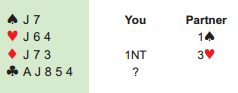
Giving false preference to 3 allows you the best of all worlds. With six spades partner can go on to 4, confident that you have a few spades. With 5-5 or better in the majors, partner can try 4 next, which you will pass to arrive in the 5-3 fit. Finally, with only five spades and four hearts, partner has the chance to bid 3NT.
Can you give false preference when holding four-card support for the second suit?
If the second suit is a minor, you might go back to partner’s first suit even though you have four cards in the second suit and three cards in the first. Although you are now less concerned about improving the contract, you may still want to keep the bidding open if game is a reasonable prospect.
Should you give false preference when holding two cards longer in partner’s second suit?
No. It is very rarely wise to go back to partner’s first suit if you have two cards more in his second suit. You are almost certainly not improving the contract. Either raise the second suit (if you have the strength to do so or are in a forcing situation), or pass.
Should you give false preference when holding a minimum?
No. When you are keen to keep the bidding low and see no hope of game, just pass. For example:

Should you ever give false jump preference?
No. If you have the values to invite game (normally about 11 points) you should make another bid. Typically this will be raising the second suit (if you have four-card support), or bidding 2NT (if you have a stopper in the unbid suit).
Should you give false preference when holding a singleton in partner’s first suit?
It is rarely right to go back to a suit in which you hold a singleton. If your own suit is not good enough to bid (again) and you lack the values to make a notrump rebid, then it is usually wise to pass before you get into any further trouble.