




Source: for Bridge Canada August 2012 By Judith and Nicolas Gartaganis
We all know how critical it is to listen carefully to the bidding around the table and to use that information as we jostle to find the best final contract. Partner’s bidding defines his hand. Many hours have been spent perfecting systems that establish narrow bounds for each bid and create sequences in which each subsequent bid refines that definition. The opponents’ bidding, too, provides important clues as to the distribution of suits and high card strength around the table.
To become a better bidder, declarer and defender, one must become proficient at making sense of all the data available from the bidding and the cards played … making positive inferences. But if you hope to become an “expert”, you must do more. To complete the picture, you must think about bids that weren’t made and the cards and suits that weren’t played ! You must be able to make negative inferences. Why didn’t partner bid spades? Why didn’t LHO lead his suit? Where are the hearts?
It is impossible to figure out with 100% certainty why an opponent did or didn’t make a play or bid. But partner …. that should be a different story. You need to be able to depend on partner’s bidding and vice versa, so it is crucial to be consistent. Don’t mess around!
Here are some examples of simple negative inferences to keep in mind. Some you will already be applying; others may be new:
• partner didn’t open : not enough points to open at the 1 level; not a long enough suit to open at the 2 or 3 level (or not even enough points to preempt!)
• partner opened, but not 1 NT : fewer than 15 HCP or more than 17 HCP or not balanced distribution
• after partner opens 1 , you respond 1
 and partner continues with 1
 : partner can’t raise hearts, therefore fewer than 4 cards in support.
Of course, sometimes inferring what partner has is more akin to “guessing”, as the following incident illustrates.
Two powerhouse teams met in the 72-board final of the 2011 Vanderbilt Teams. Much of the preliminary action in the event along with all of the semi-finals and final were shown on BBO Vugraph. Watching experts bid and play hands is a great way to study and learn about the game. Just be prepared for a little “down time” while the participants are thinking.
The match had been close all the way; with 9 boards remaining, Fleisher led Grue 116 to 114. Then … disaster! Here is the layout:
None Vulnerable Dealer: West
Arguably, one of the best pairs in the world bid uncontested to a grand slam off the Ace of trumps. Unbelievable! Levin – Weinstein let the bridge public in on their post mortem. Weinstein put a lot of stock in his partner’s decision to cue bid 4 instead of 3. He took a negative inference that his partner did not have the Ace of spades. Thus, Keycard (4) located all the missing key cards and 5, which asked for kings and issued a grand slam invite, was happily accepted by Levin. Of course, Levin didn’t see it that way. He was afraid that 3 would seem like a probe for the best game rather than a cue bid; he knew there would be no such ambiguity about 4.
Why Cheek didn’t double holding the A is somewhat of a mystery. Still, how could you possibly lose IMPs on the hand?
Well … look at the auction at the other table:
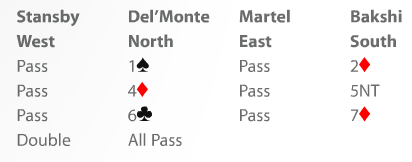 Bakshi – Del’Monte, too, brushed aside the missing trump Ace to arrive in the grand! Although they are not a long-standing partnership, they no doubt did a great deal of preparation for the event. So what happened? Over Keycard (4), Bakshi showed an even number of key cards plus a void, a questionable action since his void did not rate to be “working’: Del’Monte thought 6 asked for the void and he planned to pass 6 ( void), bid 7 if partner showed a void and bid 6NT if partner showed a void. Ah … the best laid plans. Stansby picked up 2 IMPs with his double and the Fleisher team went on to win 120 – 116.
So, what is the lesson to be learned from this hand? Making negative inferences comes with risks unless you are confident that your partner always bid consistently. Disasters happen to everyone. Be kind to partner when it happens to you!