


Source: by Paul Lavings paul@bridgegear.com for ABF
What is the Meaning of the Final bid in the folowing auctions?:
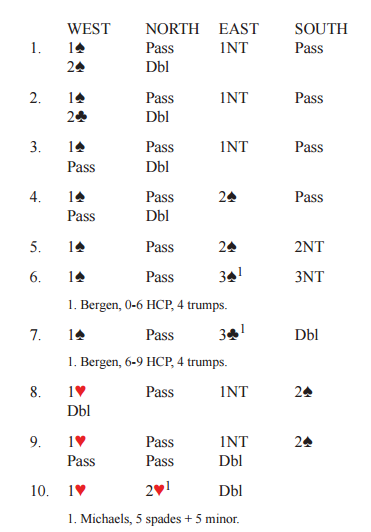
1. Penalty. You would have doubled 1 at your first turn if you had a takeout double of spades. Experts have in common a strong desire to penalise the opponents in partscores, and are on the lookout for opportunities. This is certainly one of those times. The double should show this type of hand:
AQJ83  K653
K653  A4
A4  86
86
2. Takeout. This is your first opportunity to double clubs, so the double should be for takeout. The doubler should have something like: AK53 K653 J9853 6
It is important not to allow your opponents to play low-level contracts unopposed with an eight- or nine card fit.
3. Penalty. With a takeout double of spades North would have doubled 1. North figures to hold a hand not good enough for a 1NT overcall, but with well positioned cards over the 1 opener, perhaps: AQ108, A2, J1085, Q108 But you need to discuss this with your partner. Whenever I make a double in this situation my partner bids with a good hand instead of passing.
4. Takeout. Whenever you start to formulate rules, the exception to the rule comes along. Because the opponents have found a 5-3 or 5-4 spade fit, you are unlikely to be able to double them single-handedly for penalties at the two-level. But why didn’t you double 1 for takeout? You were too weak, despite having ideal shape, perhaps something like: 2, AQ107, QJ62, 10842.
5. Takeout to the minors. Though some play this as natural, or any two-suiter, it is much more useful as a minor suit takeout, maybe even with a 5-4 holding. The priority is to not allow the opponents to play their eight-card fit at the two level.
6. To play. A close call whether to play the double as takeout for the minors, or to play, with something like: AQ, 107, AKQJ62, Q104.
7. Lead-directing. The importance of directing partner to the best lead cannot be overstated. On rare occasions, say not vulnerable versus vulnerable, the double could be construed as a suggestion to save in 5i, but I have seen many nasty accidents within that scenario. However, if partner doubled 3 and you held 632, 7, AQ2, Q108642 then you might reasonably decide your opponents are making 4, and that 5 might either make or be a great save.
8. Takeout. How else can opener ask partner to bid? The double is consistent with 2, AQ1086, K862, AQ4 With a strong balanced hand opener can bid 2NT.
9. Penalty-oriented. I would expect South to hold a hand with three good spades, something like: AJ8, 74, Q1086, K972 Clearly East won’t have a four card spade suit, but the penalties from 2 doubled could be quite lucrative.
10. Penalty-oriented. It’s important to keep the opponents honest, and double says that you can double at least one of their suits, so future doubles are for penalty. East might hold something like: AJ98, 74, K1086, K97
Paul Lavings
Postfree Bridge Books