


Monday, January 11, 2016
59 years ago, in January 1957 the The British Bridge World magazine edited by Terence Reese, published:
“This is the hand on which the debated lead of  Q was made by one of the British ladies in the European Championship. Messrs. Juan and Meredith criticised the lead, prefering the safer
  9. Mr. Truscott defended the lead and said that Mr. Schapiro agreed with him. It would be very interesting to hear some more
opinions.” and he asked its readers:
None Vulnerable, IMPs
West hand:— 9 8 7 4 Q J 4  J 7
J 7  A Q 10 6
The bidding:
| West | North | East | South |
| 1 |
|||
| Pass | 1 |
Pass | 1NT |
| Pass | 2NT | All Pass |
Lead: ?
In February 1957, the same journal published the comments of the experts: Boris Schapiro and Jack Marx in addition to a summary by Terence Reese. We decided to ask some of the best 2016 experts their leads, these were their answers, so you can compare them with the ones of the 1957 The British Bridge World magazine.
Find the past and actual experts answers below
2016 Masters Answers

Zia Mahmood: Q. Don’t want to give a trick with a club …Heart is both aggressive and may not give away a trick. I predict, heart will be 90% lead by panel

Sabine Auken: Q seems to stand out. Spade and diamond lead is more likely to help the opponents and the club suit can probably wait for a while.

Eric Kokish: 4. Partner won’t be misled but declarer might be, and I’d like to preserve my spade spots in case we can build a long trick or two in the suit. Partner will switch to a heart or a club when he wins a spade trick and figures to know more about those suits than I do on lead. Second choice is the Q, but trying to defend passively against 2NT (or 1NT) is the normal approach for the defense as declarer will often have to work hard for the contract.

Nevena Senior: I would lead a spade.The 8 if I am playing 2nd and fourth(English style-2nd from bad suits) or the 9 if attitude. I tend to lead passively after invitational sequences, specially in non fitting hands…Here oppos definitely don’t have a spade or a heart fit. North might have bid 3 instead of 2NT had he had 4 diamonds (unless it’s not natural and invitational) and if they have a club fit, they are more than welcome to try that suit. Of course they may have a 5-3 diamond fit, but who knows…

Norberto Bocchi: I lead a heart, I dont lead from AQ10. A diamond from Jx not for all the gold in the world and I dont lead a spade because if declarer has 3 cards he will guess the spade position.

David Gold: Heart lead seems normal to me. Try and get some tricks going there. Can’t lead off AQ10x as that will too often blow a trick, can wait for partner to lead that suit through. Second choice a spade, just going passive and I think that is reasonable too.

Gabriel Chagas: I would lead the Q. It’s somewhat protected, and besides from the bidding partner should have at least 3 of those, but could have 5 or more. Clubs, I have plenty of time to move this suit. Spades and diamonds are too gambling a position to take.

Sally Brock: I would lead the Q. I want to be passive as they have stopped in 2NT and the cards don’t seem to lie particularly kindly for them. I think a spade is too likely to persuade declarer to play for the drop rather than to finesse to partner’s queen perhaps. The minors also look dangerous. A heart could be bad but if partner has any honour it should work OK.

Richard Pavlicek: The Q stands out a mile, and I’d expect it to be unanimous. Attacking value is immense, often establishing partner’s fourth heart then getting a club shift through declarer. While certainly not safe, the risk is lessened with dummy showing at most three hearts.
Tom Townsend: I would led the Q, a constructive lead, of passive quality.

Benjamin Robles: I lead the Q. A spade will usually work out badly if declarer has 2 cards, as it will give up the position for possible 3 tricks. If declarer has only 1 spade then probably spade is the winning lead. But a heart just seems better as the dummy does not have 4 hearts, and if dummy has only 2, I can hit my partner’s 4 or 5 card heart suit without taking out his spade entry. A minor suit lead for me is not a possibility!

John Carruthers: I’d lead the Q. While it’s true that South could have 4 hearts, it’s also true that partner could have as many as 6 hearts. The opponents’ bidding and my balanced hand indicate that a passive lead might be best, letting declarer do his own work. Let’s look at each suit in turn. Spades: my 4 low is not appropriate as I could easily pick up an honour in partner’s hand with no return whatsoever. Hearts: on a bad day, declarer has A1098 and dummy Kxx but, on a good day, pard has Kxxxx or so and an entry. Diamonds: out of the question to lead from Jx into a suit bid by declarer, even if it’s a winner in reality. Clubs: could be a winner, but more likely to give up a trick with little in return (only a 4-card suit); and if you think to lead the CQ, place declarer with Kxx and dummy with Jxx. If I had to lead a club, I’d lead the ace for a look around. Yes, hearts is dangerous (all leads are) but there is a big upside. I don’t see a big upside to a club lead, none on a spade lead.
David Bakhshi: I would probably lead Q. A club is too aggressive for me. A spade could be good if partner has three spades, but dummy is expected to have less than four hearts (would bid 1 if 4/4) and declarer might not have four hearts, so there is a good chance that partner has four or more. If he has K or A too then Q is likely to work well.

Krzysztof Martens: Q – is my choice
- a) diamond – nonsense
- b) club – to active
- c) spade – only if South bid 1NT with singleton spade.
Jeff Rubens: It seems routine to lead the Q, to maximize safety.
Barry Rigal: Q. Second choice 9. Nothing else in the picture.

Miguel Villas Boas: 8 or 9. North seems to have four spade cards and no four heart cards, South must have 4 or 5 diamonds and can have 4 hearts. The heart lead can be dangerous, if South has 4 heart cards. A club lead has chances to give a trick, if we have 4 club tricks we can do them later. For all this my lead is 8 or 9, a card that shows the suit position to my partner.
Alfredo Versace: Q, no doubts about it.
1957 Masters Answers

Boris Schapiro: It is quite true that I did defend the lead when shown the hand: I do not agree that 9 is any safer as a lead than Q. There are many positions where 9 may “cost.” Partner can have Qx or Qxx or K10 or A10- all quite likely on the bidding. It is also extremely unlikely that you will be striking a telling blow by this lead or gaining a tempo. The Q lead, on the other hand, is much more attractive in my view. Admittedly it might “cost,” as I understand it did in this case, but one has only to find Axxx or Kxxx in partner’s hand and
the suit will be quickly established. You may even be lucky enough to find Kxx in dummy and partner holding A10xx. To my mind, the choice of leads is not even close. 
Jack Marx: From the bidding, if trustworthy, West can judge that North-South’s resources will be fully extended for the fulfilment of their contract. They must not therefore be presented with tricks in the
early rounds of any suits when, as here, there is no obvious prospect of a return in the form of an establishable suit length. I think West should therefore play a passive defence, at least until he learns more about the hand from a view of the dummy. This seems best represented by the 9 as being least likely to give anything away. 

Terence Reese Sums up: The point originally made by Juan and Meredith- that this particular auction calls for a tight defence is sound; so, too, is Konstam’s remark that you have too much yourself to play for partner’s hand, and that in so far as you have an attacking objective it is to put partner in to lead a club. It strikes me as perverse to pretend that 9 is as likely to give away a trick as Q. It will not necessarily do so in the situations mentioned by Schapiro. The Queen from QJx, on the other hand, is one of the most costly leads in the game. I think that Q is a dreadful lead-risky in defence, destitute of attack.
These is the part of the article with the hand (By Alan Truscott)…played 59 years ago.
The British ladies in the Stockholm Championships: It appears that Messrs. Meredith and Juan, who last
month in Pride and Prejudice announced that they were depressed by a study of 20 boards from one match, have their own variation of the theme: ” l am reading these to be depressed, and I won’t write in until I am.”
This famous pair, better known as players than as writers, objected to my statement that Miss Shanahan made fewest mistakes among the ladies in Stockholm, a verdict confirmed after careful study of all the records by two independent male experts. Let us look at some of the evidence offered by the opposition.
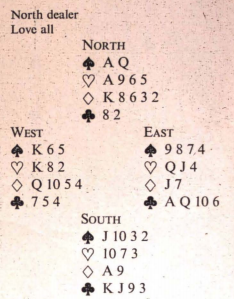
South bid One Spade over One Diamond, and raised North’s rebid of One No Trump to Two No Trumps. Pedro and Plum (hereafter called P. and P.) comment as follows: ” No trump contracts reached in this fashion can often be defeated by tight defence. The opening lead of the 9 is the orthodox play which keeps declarer to 7 tricks. East’s opening lead : Q. It cost 4 IMPs” The lead of the Q has been endorsed by Boris Schapiro and a number of other experts. On the bidding it is distinctly odds against either opponent holding 4 cards in hearts, and the heart lead would certainly get my vote. Moreover, a study of the four hands makes it clear that the lead of 9 by no means necessarily ” keeps declarer to seven tricks.” The ” chuck “: 4 IMP by P. and P.