


 Source:
Bridge players are experts at interpeting information. We interpret information every time we count out a hand. If LHO is known to hold 12 non-diamonds and he has followed to the diamond ace, then he is now out of diamonds and we can therefore be certain RHO holds the remaining outstanding diamonds. That is fairly straight-forward reasoning. There are many situations where information does not create certainty, but it shifts odds in favor of one action and those cases are more frequently overlooked.
The Barking Dog
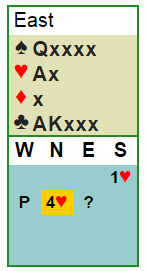
 Qxxxx. It seems quite risky to stick your nose in at the 4-level on that suit. What information does the auction provide to guide us?
The opponents hold 26 cards between them, 10 hearts and 16 non-hearts.
Your side holds 26 cards, 3 hearts and 23 non-hearts divided into three suits. Even if those 23 cards are divided fairly evenly they will be divided: 8-8-7 or 9-7-7. Thus the fact that the opponents hold a 10-card fit means our side necessarily either holds a double fit, or at least a 9-card fit in one suit.
Any time your opponents have shown a big fit, if your hand is worth a call, you can enter the auction on weakish suits with confidence. The chance of catching a fit is much higher than if you were overcalling a 1 opening.
This example showed a positive inference, what I called a barking dog– the opponents made a definite statement about their heart length in the auction, which allowed us to infer that our side had a better than normal chance of holding a spade fit.
The Dog That Did Not Bark

Information can come both from actions taken and not taken. What does this auction suggest about the opposing distributions? Both players are probably fairly balanced. Given that the opponents have some high cards, if either had some shape, they would often have entered the auction. The negative inference that the opponents rate to be flat may help you play the hand. For example, at matchpoints you may decide to take a risky line that could score an overtrick if trumps are 3-2 but risks going down if they are 4-1. The practical odds that trumps are 4-1 have declined considerably.This is an example of negative inference. The absence of an overcall or double from the opponents allows us to conclude neither opponent has much distribution. This is similar to the negative inference Sherlock Holmes draws that an intruder can not be a stranger when the dogs fail to bark in his presence.
Predicting the Future

Suppose that as dealer you hold a spade void. What does this information allow you to predict? The opponents almost certainly have extra spade length. Chances are excellent that LHO is about to bid 4. Rather than bidding a wooden 4, you should be asking yourself questions like:
- Would 4-of-a-minor help partner decide what to bid over the coming 4 bid?
- Should I bid 5 in front of LHO to force him to guess at the 5-level?
In this case, the spade void provides a positive inference that opponents hold extra spade length. We combine that with our practical experience to realize LHO is likely to bid 4 at his next turn. Fortunately, we receive that information in time to do something useful with it, such as a cooperative 4-of-a-minor bid so partner can evaluate when we should or should not compete to 5.
Inferences from Guesses
Any time an opponent is forced to make a decision with incomplete information, we can draw inferences. Whenever an opponent must guess to chose his action, we can gain information by asking ourselves about the choices he did and did not make. This occurs frequently with opening leads.
For example, you reach a contract of 6NT. Assume that your auction meant LHO had a choice of either minor. Annoyingly, he leads a passive club instead of a diamond that would have solved a 2-way finesse for the  Q. How does this lead help us decide how to play the hand?
If LHO had held equal holdings in the minors, for example xxx and  xxx, he would have had a guess and he might have guessed to lead a diamond. The actual club lead suggests his choice in the minors is probably unequal. He is less likely to have equal minor suit holdings than unequal ones. So LHO is either short in diamonds, or he has a diamond honor to make his holdings unequal. Cash some winners and try to get a count. if LHO has some diamond length, play him for the Q on the theory he might have led a diamond if he did not hold it.
You may recognize this type of reasoning as a form of restricted choice. When LHO has equal choices between options, the fact that he chose option A implies that option B looked worse to him.
Once again this is a negative inference. We reason from something that did not occur (a diamond lead) to draw a conclusion about the original layout.
Conclusion
Pay attention for both direct and indirect sources of information. Every bid, every card adds to your picture. A bid or play that was the percentage play without information may now be poor, or a play that was an extreme risk without information may have become safe. So look for how odds change as you acquire more information!