





Source: 2001 European Junior Camp; Stargard
Long Suit Trial Bids After Major Suit Agreement
In the early days of bridge, if your partner opened one of a major and all you could do was give a single raise, you had three options. You could pass, go directly to game, or make an unscientific raise to the three level, asking partner if his hand was minimum or maximum. It was quickly realised that there are better ways of dealing with this situation. To begin with, a raise by opener to three of either major, is used pre-emptively to prevent the opposition from re-opening the auction.
If the opening bidder is not strong enough bid game on his own, but thinks one might be possible if the responder has a good raise to the two level, he can make a Trial Bid. There are several variations in use, but we think the simplest method is to bid the suit in which you need some help. This could be a genuine second suit, or it may be a poor three card holding, sometimes even three small cards. That is known as a long suit trial bid.
An alternative is to make your trial bid on a shortage, usually a doubleton or singleton — a short suit trial bid. A partnership must know, and state, whether it employs long or short suit trial bids. Any form of trial bid is unconditionally forcing for one round. It has been agreed that the partnership will play in their major suit fit, and it is merely a question of whether it will be at game level. Opener guarantees that his major suit is five cards in length when he rebids another suit at the three level. If his longest suit were only four cards in length he would have a balanced hand and he would have opened or rebid in no-trumps.
From the simple fact that opener doesn’t pass the two-level raise, he is known to be better than minimum. In fact he must be reasonably good, because he already knows from the single raise that responder is limited to nine points and a four-card trump fit. Look at the following example:
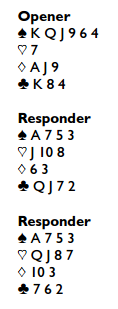
You open One Spade, and game is almost certain to be made if your partner holds the first hand, and almost equally certain to fail if he holds the second. You could pass or take a flyer at Four Spades, but finishing in the right spot will be a matter of luck. This is not so if you select clubs as the suit in which you need help, and bid Three Clubs. The following are responder’s replies.
Responding to the Trial Bid
1 On a minimum hand, wherever his values, responder should convert to opener’s suit at the lowest available level.
2 On a maximum, or near maximum hand for the two-level raise, he should convert to opener’s suit at game level.
3 If doubtful, he should let his holding in the suit in which opener has made his trial bid decide the issue, bidding at the three-level if he lacks ‘help’ in the trial-bid suit and going to game if he holds help
Applying these guidelines to our original example, responder is maximum for his raise of One Spade to Two Spades. When opener trialbids Three Clubs, go straight to Four Spades. On the second hand, though technically ‘maximum’, it’s a poor hand for anyone wanting to play in Four Spades, and asking for help in clubs, so just convert to Three Spades.
Here are three hands which you, as responder, might hold when partner has opened One Spade and you have raised him to Two Spades.
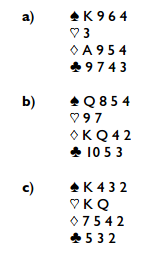
Holding hand (a) raise partner to Four Spades no matter which suit he makes the trial bid in. Heart losers can be ruffed in dummy and a holding of either minor facing your 4-card length should allow declarer to develop ten tricks. With hand (b) a trial bid in hearts or clubs from opener does not improve your hand and you should sign off with Three Spades. If the trial bid is in diamonds, jump to Four Spades. Hand (c) looks quite attractive but no matter what the trial bid is made in, sign off at the three level. The doubleton  KQ will not play its full value, even if partner’s try is in hearts. There will be too many minor suit losers. Remember that the point count for opener’s bid is around the 17 point mark. With a stronger hand he would have bid the game outright.
Trial Bids After Minor Suit Agreement
Trial bids after responder has raised opener’s One Club or One Diamond are played quite differently from trial bids after major suit agreement. They are directed almost invariably to exploring for the easier game in no-trumps. Opener guarantees a hold on the suit he bids and by inference declares a weakness in another suit, which he hopes responder can stop. After a single raise it is rare for opener still to be trying for Three No – Trumps but take the following hand:
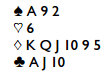
Responder raises your opening One Diamond to Two Diamonds and you don’t need much imagination to see that if he holds the  A the suit is good for six tricks. You have the two black aces, but are still a long way from nine tricks. On the other hand, Three No-Trumps, with that singleton heart, looks equally fraught with danger. Now, however, you have the means to ask partner whether he has a stop in hearts. Make a trial bid of Three Clubs and, if he shows a heart stop by bidding Three Hearts, you can bid Three No-Trumps. It may be even better to bid Three Spades, allowing partner to bid No-Trumps, but you need to be on the same wavelength! If he skips hearts and shows a spade stop with Three Spades you can go back to diamonds.
When the bidding starts One Club—Three Clubs or One Diamond—Three Diamonds and opener has a reasonably balanced hand of about 15/16 points, the partnership needs to explore the possibilities for playing in Three No-Trumps before committing themselves to a part-score or game in a minor suit. Look at these hands:
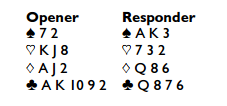
The opening bid of One Club is raised to Three Clubs. If responder can stop the spade suit, then Three No-Trumps ought to be a fine contract. So opener now bids Three Diamonds and receives the reply of Three Spades, which is all he needs to bid Three No-Trumps.
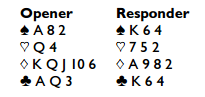
The bidding goes One Diamond — Three Diamonds and opener’s rebid of Three Spades invites partner to try Three No-Trumps if holding a stop in hearts. This he cannot do and the partnership retreats to Four Diamonds. You will note that the bidding concentrates on showing stops in the majors and takes minor suit stops for granted. It is, of course, possible to show a hold on a diamond suit when your fit is in clubs, but not the other way round.