


Source: http://www.vba.asn.au
Nil vulnerable
That 2 bid is usually played as weak: about 6-10 HCP and a decent 6-card suit, just like an opening bid of 2. Its primary purpose is to make life miserable for your side, and it often succeeds.
What are your options as responder? Well, bidding a new suit (necessarily at the 3-level) shows quite a bit of strength, given the bidding has been jacked up high: certainly at least 10 HCP, and usually at least a 5-card suit.
Notrump bids are natural and non-forcing, as is a supporting bid in diamonds.
Then there’s the negative double: this shows points, at least 8 HCP, as again the bidding is up higher, and specifically interest in any unbid major. In this particular auction, at least 4 hearts is guaranteed. (In an auction where your partner opens a minor, and they intervene in the other minor, things are more difficult, as there are now two unbid majors.)
And when all else fails, and you have only a moderate hand, you can always pass: partner is still there. You certainly don’t have to bid with around 6-9 HCP, if nothing fits.
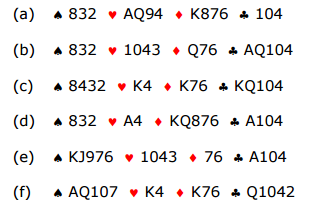
How do you cope with the weak jump overcall with each of these hands?
⇓
⇓
⇓
⇓
⇓
⇓
⇓
⇓
⇓
⇓
⇓
⇓
⇓
⇓
⇓
(a) A 7 4 3  8 5 2
8 5 2  K J 6
K J 6  Q 4 2
Q 4 2
(a) 832 AQ94 K876 104 Double. This is the way to show your hearts. The short clubs is not really a problem: if partner bids 3, you can convert this to 3, a non-forcing bid.
(b) 832 1043 Q76 AQ104 Pass. A perfectly good hand (you were about to respond 1NT to partner’s opening bid), but nowhere to go after the pre-empt. Let’s see what partner bids, if anything. This auction could get sticky later, but nothing good can come of you mis-describing now.
(c) 8432 K4 K76 KQ104 3. Another awkward hand, and this time you are too strong to pass. 3 usually indicates a 5-card suit, but there is no ‘never’ in bridge. A negative double is out: you cannot control things if partner bids hearts. If partner rebids 3 over 3, you can pass.
(d) 832 A4 KQ876 A104 3. You have enough points for a game, but where? 5 is a strong possibility, but you have to keep open the possibility of 3NT if partner has a spade stopper. The 3 bid gets the job done: it logically shows diamonds (if you’d had some other suit, you would have bid it), and enquires about a spade stopper.
(e) KJ976 1043 76 A104 Pass. You really want to play 2 doubled, but a double here is not for penalties. You need to hope that partner can come back with a takeout double: quite likely, as he is short in spades. Then pass with a sadistic smile.
(f) AQ107 K4 K76 Q1042 3NT. You could pass, hoping that partner doubles: the carnage would be something to behold. But who wants to take years off their own life by waiting for partner to re-open? You simply cannot risk defending 2 passed out. So bid what you know you can make.