




Source: http://wimpy.biz/kibitzer/ 


Did you Read UDCA Post? Click Here
In this post I’ll finish up my brief discussion about upside down signals. Suppose you are West and hold:
64 AJ65 Q8 86542 and hear the following auction: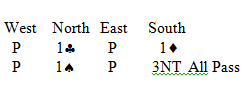
You try the 5 and dummy hits with:
Let’s save the debate over whether North should have opened 1 for a later time. Dummy’s K holds as partner plays the 9. This is an attitude card (UDCA) denying the Q. (If dummy had won the trick with the Q or less, it would have been a count card). South plays the 3. It would seem we hit upon the best lead. Declarer certainly doesn’t hold 5 hearts on this auction and might only have 2 or 3. Declarer leads a low club from dummy but partner alertly rises with the A (of course you know why), – declarer dropping the J – and returns the 4. Declarer plays the 10 as you win the J. Now what?
Who holds the 2? If it is partner, he started with 5 hearts and your Ace will fetch the Queen. If declarer has hidden it, (the sneaky cad) you might be just handing him his game going trick. How can you tell? Is it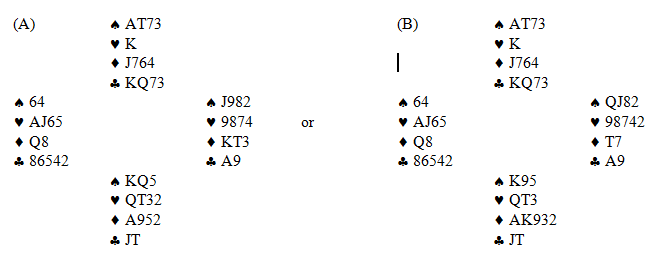
In (A), you must exit passively with a club (or a spade) and wait for the setting trick. In (B), if you don’t cash out now, declarer will take the rest. Note that in (B), if partner hadn’t jumped up with the §A, that having stolen a club, declarer could have run off with 9 tricks. While you can’t always be certain how many tricks declarer can take if you don’t cash out immediately, you can be certain whether or not declarer has one heart left or two.
One of the minor flaws in the traditional method of giving count is that a defender is supposed to lead or discard his original 4th best when giving count in the suit partner led to trick one. This can create confusion when you can’t be certain whether partner started originally with 4 or 5 cards in the suit. The 4th and 5th highest cards will usually be close to one another making it difficult to tell the difference. A much superior method is to lead or discard low from a current odd numbered holding, and high from a current even numbered holding.
Thus, in our examples above, East would return the 4 in the first example, and the 8 in the second. West has no problem at all determining whether the 8 was from a current holding of four or a doubleton, and correctly bangs down the A to defeat the contract. In the second example, West has to guess whether or not declarer has 10 tricks or more if he doesn’t cash out, but he knows that leading the A will not set the contract. In a team game or knockout, this could easily be the difference between winning and losing.
This same method (leading or discarding high from a current even holding and low from a current odd holding) can be useful when we are giving later count after a preempt. Say you open 4 and end up defending. You lead the K and declarer wins the Ace. As declarer starts running his long suit, your first diamond pitch should be low if you opened with 8 diamonds, (currently 7) and high if you opened with 9 or 7, (currently 8 or 6). It’s simple and can be critical information for partner.
This treatment does not override common sense! In situations where count is not critical, you still use the same method as always, namely low when you want the suit returned, and high when you don’t. Only when you are interested in giving partner the count in the suit (and he should recognize those situations), should you employ this signal. It is most often used when returning partner’s lead, either immediately or later in the hand.
You can use the same method when discarding. Assume partner has led a suit, you played third hand high, and declarer wins the trick. If declarer starts running a long suit, your first discard is usually some type of attitude signal. That’s fine. The first time you pitch a card in partner’s led suit should be a count signal. Once again, it should be the same card you would have led if you were on lead.
For these two UDCA posts, I’ve been pleading with you to adopt UDCA signals. They’re superior and few will dispute it. Upside down attitude (key benefit) requires a switch to upside down count. This is because count and attitude are often inescapably linked. How does this factor into this month’s tip? This month, I’m endorsing a count method (in specific situations) of high from even and low from odd. In case you haven’t been paying attention for the last 60 years, that’s known as standard. Am I reversing my stand on UDCA? Not at all.
You can use both. Play UDCA for all suits the first time they are played, no matter who led it. Once a suit has been played, whether you’ve given the count or not, switch to standard current count for the remainder of the hand for that suit. In all count situations, lead, discard, and follow high from a current even number, and low from a current odd number. Attitude does not change, that is, remains upside down.
If this is all too much, simply stick with UDCA signals throughout the hand. Your defense will improve. If you and your partner are able to incorporate this slight count modification, your defense may dazzle.