


Source: Bridge: 25 Ways to Take More Tricks as Declarer By Barbara Seagram, David Bird 
[quote style=”boxed”]It is always better, other things being equal, to take a finesse on the second round of a suit rather than the first, as you have the additional chance of dropping the card finessed against. W. Dalton. Practical Bridge. 1908[/quote]
Even within a single suit, there are many hundreds of card combinations possible. It is not practical to learn all the ‘best plays’ and you will often have to work them out at the table. How do you do this? Let’s look at a typical holding: 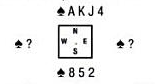
A bridge colleague of yours shows you this suit, scribbled on the back of an old scorecard.’What is the best play here?’ you are asked. What should your reply be?
You cannot give an answer unless you know how many tricks you need from the suit. Suppose you need all four spade tricks to make the contract. You would have to finesse the jack, hoping that West started with Q-x-x. Suppose instead that you need only three spade tricks. What would be the best play then?
If you made the same play — finessing the jack — you would fail to make three tricks when East started with a doubleton queen in the suit. To give yourself the best chance of three tricks, you should play the ace and king first (possibly dropping a doubleton queen with East). If the queen does not fall, you will return to the South hand in a different suit and lead towards the jack of spades on the third round. If West holds the queen, or the suit breaks 3-3, you will make the required three spade tricks.
That was a typical safety play. You played as safely as possible to make the required number of tricks. There was a small price to be paid: you would not make four spade tricks when West held Q-x-x in the suit. That is true of many safety plays: you surrender a possible overtrick in order to give yourself the best possible chance of making the contract. Here is a similar combination for you to try.
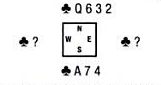
If you need three club tricks you should lead low to the queen, hoping that West holds K-x-x (it makes little difference if you play the ace first). Suppose you need only two club tricks. What then? MI will be easy when the suit breaks 3-3 or West holds the K. There is nothing you can do when East holds four dubs including the king. What if East holds K-x? Yes, you can improve your chances of two tricks by cashing the ace and then ducking a round. When the king is doubleton, it will appear on the second round. If it doesn’t, you can return to hand and lead towards the club queen on the third round, still making the required two tricks when West holds the K. How would you tackle this combination?
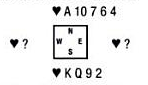
You reach a grand slam in hearts and note that you will go down only if you lose a trump trick. What is the safety play to avoid such a loss? When you are missing four cards to the jack you must aim to keep a high card over the jack, whichever defender has all four cards. You do this by cashing an honor from the hand with two honors — here you will start with the king (or queen). If West holds J-x-x-x, you will finesse dummy’s ten on the second round. If East holds J-x-x-x, you will cross to the ace and finesse the nine. Most players get that one right but they may falter on the next combination, which is confusingly similar. How would you play this spade suit to give yourself the best chance of five tricks?

If you start with the ace or king, you will not succeed against J-I0-x-x in either hand! To pick up such a holding, you need to have two higher honors over the jack and ten. You should therefore first play the honor in the hand that con-tains only one honor (the queen, here). If West started with J-10-x-x, you can now score all five tricks. You lead towards the A-K-9 on the second round, plan-ning to finesse the nine. If West prevents this by playing one of his honors —’splitting his honors, as it is called — you will win the trick and return to the South hand to finesse against his remaining honor. (If East started with J- 10-x-x, there is nothing you can do about it.) How would you play this suit?

| By the Way |
Do you see why it is wrong to play the king first? It East holds a single queen, you cannot scorn lour tricks anyway. It West holds a single queen, you must play low to West’s queen and dummy’s ace, cashing the jack next and then finessing the nine. |
Once again, the correct answer is ‘How many tricks do 1 need from the suit?’ If you need all four diamond tricks, you do best to finesse the jack on the first round. You need West to hold one, two or three cards including the queen.
Suppose you need only three diamond tricks. Is there a play that succeeds against Q-10-x-x with either defender? Suppose you start the same way —finessing the jack, which loses to the queen. If you play the king next, you will lose two tricks when East has Q-10-x-x. If instead you play the ace next, you will lose two tricks when East’s  Q was a singleton.
Perhaps you should start with a low card to the nine, intending to play the king next? No, you would lose two tricks when West started with a singleton ten. The best play is to cash the ace first and then lead a second round towards the nine. If East follows, you finesse the nine. Either the finesse will win, West showing out, or the suit will break 3-2. In both cases you will score the three tricks you need. Suppose next that East shows out on the sec-ond round. You simply rise with the king and lead back towards the jack. This is a 100% safety play for three tricks against a 4-1 break. As you see, it can be quite arduous to work out the best play. Experienced players would be familiar with that last combination and would know straight away how to play the suit.
Do you see why it is wrong to play the king first? It East holds a single queen, you cannot scorn lour tricks anyway. It West holds a sin-gle queen, you must play low to West’s queen and dummy’s ace, cashing the jack next and then finessing the nine.
The safety play on the next combination is perhaps easier to calculate:
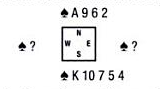
You are playing in six spades and have no losers in the side suits. How will you give yourself the best chance of avoiding two trump losers?
Suppose you play a low card to the ace. You will lose two trump tricks when West started with Q-l-x-x. A low card to the king is just the same. If West shows out, you will lose two trump tricks. Let’s try playing low to the nine instead. If East wins with the queen or jack, the suit will have broken 3-1 at wont, so there will be only one loser. If West started with all four trumps, the nine will win on the first round. What if West shows out when you lead low towards dummy? You can either finesse the nine, losing to East, and finesse the ten later. Or you can rise with the ace and lead low to the ten on the second round, forcing East to split his honors. (Leading a low card to the ten on the first round is just as good, of course.)
| By the Way |
| At matchpointed pairs, (i.e. regular duplicate games) where an over-trick can make a huge difference to your score, the considerations are different You do sometimes have to risk your contract in the search for a valuable overtrick. |
I may lose an unnecessary trick if the spade suit breaks 2-2; you may be thinking. it’s perfectly true, but trumps will break 4-0 every now and again and it is more important to guarantee the slam than to chase an extra 30 points!
Summary
✓ Calculate the best play in a suit by seeing how many lies of the defenders’ cards each particular play will succeed against.
✓ Often the safe way of playing a suit will give up the chance of an overtrick. Don’t worry about that. It’s a good investment.