




Source: ACBL
When you play a hand, you need to plan not only the current trick, but the succeeding tricks as well. In this article, you will be shown a hand and how it was played. At the end, you will be asked to determine where the play went wrong and what should have been done about it.
North had the kind of bidding problem that we all dream about. East opened a weak two spade bid, and when that bid came around to North, he found himself with a lot to think about. How would you handle the North hand with its twenty-four high card points? Actually, calling this a twenty-four high card point hand does it an injustice. It has controls, excellent quality points, and a solid suit. North ‘solved’ the problem by starting with a takeout double, reserving his decision until later. This worked well because South had enough to jump to four hearts. North still was not out of the woods but solved the problem in typical fashion. He used Blackwood, found that South had one key card, and selected seven diamonds as the final contract. This auction had the effect of getting East to lead out of turn, but he was stopped before any damage was done. West, when informed that it was his lead, showed that he had heard East’s spade bid and led the eight of spades.
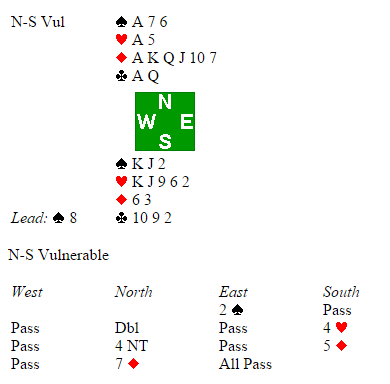
Declarer played the hand rapidly and efficiently. He played low at trick one and took East’s queen with the king. West had four diamonds so it took four rounds to get them all. Turning to hearts, South played off the ace and king and ruffed a heart in dummy. If they divided or if the queen came down, seven diamonds would make, but not today. West had four hearts to the queen-ten, meaning South could not set up an extra trick there. This left South with the club finesse. He came to his hand with the jack of spades and tried finessing the queen of clubs. East produced the king and that was that.
What went wrong? Was the contract too aggressive or should it have been made? Looking at the two hands, especially given that East opened two spades, bidding seven diamonds is reasonable. It makes if something good happens in hearts or if the club finesse works.
The real error was in the play. On the lie of the cards, seven diamonds was cold. The fault? The fault, as so often is the case, was the play to trick one.
Question. After East opens two spades and West leads the eight, what are the chances that East has the queen of spades?
| 50% 60% 70% 80% 90% 99% GREATER |
I can’t imagine East not having the queen of spades. This is as close to 100% as anything I have ever seen at the bridge table. It is not necessary for you to play low from dummy at trick one. There is no need to ‘take’ the free finesse and there is a good reason not to. As long as you are willing to credit East with the queen of spades, you can make seven diamonds via the following.
- Win the ace at trick one.
- Draw four rounds of trump, keeping all of your hearts.
- Play two rounds of hearts and ruff one in dummy. You will see that West still has a heart stopper.
- Finesse the jack of spades. It is a little unfair to describe this as a finesse because a finesse is usually associated with some amount of risk. In this case, you know it will work.
- Ruff another heart in dummy.
- Now, courtesy of your play at trick one, you still have an entry to your hand to use the good heart. Play to your king of spades and discard dummy’s queen of clubs on the good heart. Making seven.
Here is the complete hand:
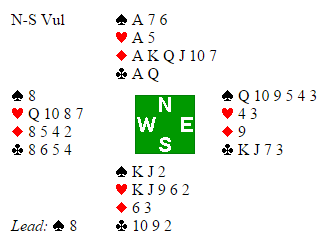
Except for the fact that East has a light weak two bid, the cards are more or less as you would expect.
One last question in closing. Would you have opened the East hand with two spades in first seat, not vulnerable against vulnerable?
I hope so. This is a continuing theme that is proved over and over on a daily basis. Quiet opponents are overcome more easily than busy opponents.
Don’t be quiet. Don’t be passive. Be heard, over and over and over. Eventually, you will find the proper level of being expressive. Keep trying until you find it. In your search, you should note the level that works for your opponents against you. In time you will achieve that most rewarding accolade. “Oh. I am so glad that we are skipping over your table.”