


Source: ACBL
At IMPs you focus on beating the contract. Defense at matchpoints is harder because you must aim at a moving target. Your goal may be to hold declarer to one overtrick or to try for an extra undertrick.
Defending a low-level contract such as 1NT can be taxing. Here, West leads the  5, and your king loses to the ace. Declarer rides the
  8 to your queen, and you return the 10 to his queen, West following with the deuce. Next, South passes the J to your king.
At IMPs you would shift to clubs: West must have something good in that suit to beat 1NT. At matchpoints a case exists for a spade return to let West cash out. At worst you’ll be minus 120, but if you return a club you might find South with:
 At matchpoints, defenders often set a trick target that will assure a good result. After South takes the push to 5 and is doubled, West leads his singleton club.
When dummy plays low, East takes the ace and returns the  6. When West ruffs, he should cash the
  K. East’s suit-preference 6 suggests weakness in hearts, but West should settle for down one in any case. East–West already have the better of the deal. South made a los-ing decision to bid 5 — 5 would have failed — and East did well to double 5 and to take the A. East–West will get a good result for plus 200, but if West greedily tries for plus 500 by underleading the A K to get another ruff, he’ll be minus 850.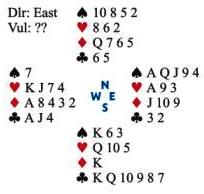
West leads his singleton spade, and East takes the ace and returns the Q.
West ruffs South’s king and shifts to a low heart. East takes the ace, cashes the J and leads a heart, and West collects the jack and king. South is down one already. At equal vulnerability or if only North–South are vulnerable, West should cash his A next, guar-anteeing down three and beating East–Wests who bid and make a game.
If only East–West are vulnerable, West must consider underleading the A. His decision to play for a penalty won’t appeal to many Wests, who will instead bid 2 or make a negative double. Even if East lacks the K, East–West appear to have a game, and the result at many tables may be plus 630. To avoid a poor result, West may need plus 800: If East has the K, he can get in to lead a fourth spade, promoting West’s J.