


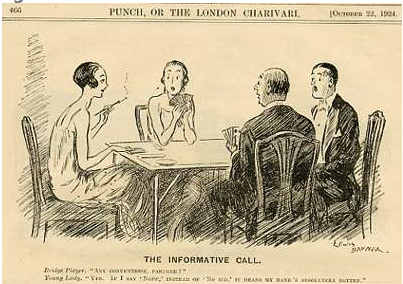


Source: The Kibitzer Fall 2014
This deal is from the Friday night Worldwide Pairs game held at our club. It contains many instructive lessons in both play and defence. I have slightly modified the hands, switching the opposition of the king and jack of hearts in order to present an extra lesson.
This might change the auction, but will have no impact on the final contract. Rather than presenting it as a problem, I thought it would be more beneficial to see all four hands from the beginning.
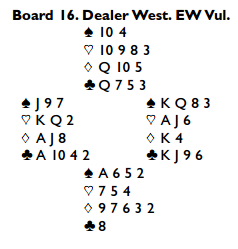
Lesson 1: West opens one notrump. East, who knows the magic number for six notrump is 33 high card points, could have bid four clubs (Gerber, asking for aces), just to make sure they weren’t missing two of them. Instead, feeling an urgent need to “wash his hands”, he just blasted to six notrump. If you are a slave to high card points when you are bidding a hand, you are doing yourself a disservice, because good bidding is based on the length of your suits and the degree of fit(s) that you and your partner have. Note to die-hard highcarders: it is often wise to deduct a point on 4-3-3-3 hands because they don’t play very well. The West hand has a ten, nine, eight and seven to make up for it being a questionable one-notrump opener.
Lesson 2: Do you make an active lead or a passive lead? Sometimes the opponents have found a trump fit and suggested a long side-suit as a source of tricks. That is the time you should attack (active). Attacking can mean leading away from your unsupported honour in the hope of finding partner with something worthwhile in the suit. Sometimes it is not clear that you need to attack, or your hand does not seem to have a suitable suit for attacking purposes. That is the time you should make a neutral lead (passive). A neutral lead is sometimes from a sequence such as queen-jack-ten or jack-ten-nine, or a lead from any bad suit that is not likely to give declarer a trick.
Sometimes a lead can be both aggressive and neutral at the same time, such as a lead from a kingqueen-jack sequence, which may build a trick for your side but give nothing to declarer.
It is often difficult to decide on opening lead whether to be active or passive. After the opening lead, you may continue to be active or passive, but oftentimes you will switch back and forth between the two, depending on how the play has gone. I have found that is hard for normally aggressive players to learn to go passive and for normally passive players to learn to go active. Work on it. On this hand, North leads the ‘passive’ ten of hearts.
Lesson 3: Count your tricks. Declarer can make three spade tricks (if he is lucky), three hearts, three diamonds (if the queen is onside) and two clubs, which adds up to only 11 tricks. It is clear that you need to find the queen of clubs. If you make four club tricks, you won’t need the diamond finesse. If you only make two spade tricks, then you do need the diamond finesse. UGH! You need to try spades first in order to find out whether you need two or three diamond tricks.
Lesson 4: The best way to play this kind of spade suit is to lead twice towards the hand with two honours in the suit. If North has the doubleton ace, it will pop up on your second lead of the suit without your wasting an honour. If South has the doubleton ace, you were always going to play an honour to force the ace and you were always going to have only two spade tricks, the ten being set up as the master in the suit. You have too many problems on this hand to ever think about finessing for the ten of spades. So you win the tenof-hearts lead with the king and lead the seven of spades to the king. If South ducks the first spade, lead a heart to your queen and try spades again. When the ten appears, you have your three spade tricks. If South wins the first spade and leads a heart, you achieve the same result.
Lesson 5: On the third and fourth rounds of spades, North will probably throw hearts. You can then cash your last heart and the ace and king of diamonds (you throw the diamond eight from West on the fourth spade and North pitches a diamond as well). At this point, you have seen North play:

Does this not strongly suggest to you where the queen of clubs might be? You play the ace and then the ten of clubs for a finesse and score up a well-earned 1440 for six notrump bid and made. The club suit was left to the end because playing the other suits first will often give you enough information to determine who is more likely to hold a certain card in a suit. The odds will tell you that when you are missing five cards in a suit and one opponent is known to have three or more cards in that suit, that is the person more likely to have the card you are looking for. Sometimes, the play to the crucial point of the hand will tell you that a certain opponent has all five of the cards in the suit you were worried about!
Lesson 6: An expert North player who is aware of what you are doing might be able to fool you in either of two situations: (i.) On the actual deal, North might discard a club, leaving you to wonder whether he had only low clubs and thus no queen, or; (ii.) If he had started with  Q107652,
  3, he might play his diamonds in the order five, ten, queen, knowing that his diamonds were useless from your plays in the suit. In the end, he would have 762, 3, and you would go down. What could you do? Nothing!
Sometimes a good player will see what you are doing and devise a strategy to fool you. You will pay the price, sincerely say, “Nicely played,” and move on to the next deal. You cannot play every deal against sneaky expert players as if they are doing something to fool you. Be aware of the small plays they may make to fool you, but reward them if they make a big play that works. If you spend all your time worrying about a big con job, you will end up giving away more matchpoints or IMPs by messing up the simple deals.
[box type=”tick”]COUNTING Count your winners and count your losers. If the total doesn’t come to 13, count your cards. Alfred Sheinwold[/box]