




Source: February 2016 ACBL Bridge Bulletin 


Good hand evaluation depends on deciding how well your secondary honors mesh with partner, plus the impact of distribution. Raw point count is only the first step. Would you rather hold a queen that helps take a trick, e.g., Q,-x-x facing K-J-x-x, or a king that is wasted, K-x-x facing x-x-x with the ace likely offside?
If partner bids your Q-x-x suit, that is a good sign. If LHO bids your K-x-x, that is ominous. There is no formula to tell you how much to add or subtract, which is just as well since it is important to escape point-count prison and mechanical counting. One of the most common and dismaying comments I hear is when players say, “I couldn’t possibly bid 4; I only had ‘X’ points,” or “I had to bid 4, just look at all my points.”
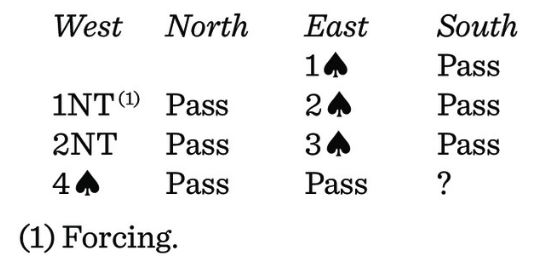
The best we can do is to upgrade or down-grade our original evaluation when the auction furnishes clues. Let’s say you (South) hold: Q J 9 2 A 8 5 7 6 2 A 9 7. Playing matchpoints, the auction:
(1) Forcing.
Do you double? I hope so, because you rate to have the contract beaten in your own hand: two well-located spade tricks behind the long spades and two aces. It is possible that East holds a heart or club void, but that must be against the odds. If 4 is a normal contract and you defeat it one trick undoubled, expect a poor matchpoint result.
Same auction, but this time you hold: Q J 9 K J 10 Q J 10 2 K 9 7. Would you double 4? I hope not. Your 13 HCP don’t rate to produce many defensive tricks. West has announced a balanced 10-12 points; don’t be surprised if either your K or K, or maybe even both, are swallowed up by a finesse. Your values are poorly located which diminishes their value.
Try another: LHO opens 1, partner intervenes with 2NT (minors) and RHO raises to 3, opponents vulnerable. Which of the following two hands has greater offensive potential?
A) J 7 5 J 8 76 Q 9 5 2 K 2
B) Q 5 4 Q J 7 6 2 5 2 A 8 2
The answer is hand A by a wide margin. Facing a distributional partner, think tricks, not points. Assign partner a representative hand for this auction. Given that the opponents seem to hold at least half the missing points, let’s give partner a minimum: A x x x K J x x x Q J 10 x x. Match that to hand A; in a diamond contract, there is one spade loser, two hearts, one diamond, and one club. Meanwhile, on defense, the opponents have an easy spade game, perhaps even a slam. These calculations strongly suggest a jump to 5. It rates to produce a worthwhile sacrifice, down three doubled, minus 500 against a vulnerable game.
And if the opponents have a slam, your jump blocks Blackwood, forcing them to guess their correct level. Your hand became much better than its point count because you fit partner’s two-suiter so well. In contrast, Hand B rates to go down at least a couple in 4 against average splits, and your defense against 4 is uncertain. Much depends on how distributional the opponents’ hands are, and the location of the K. Expect declarer to guess spades correctly; the unusual notrump often provides declarer with a roadmap.
Why bid 4 and goad them into a contract they might not reach on their own, meanwhile risking a penalty double of 4, down a few. 4 is apt to offer the opponents a fielder’s choice: Whether they bid 4 with extra shape or double holding balanced strength, they are likely to be successful. This analysis of the tactical possibilities is lost if all one does is count points.