





Suppose that the author of a comprehensive guide to bidding theory decided, for some strange reason, to begin with the commonest sequences and conclude his masterpiece with bids that might come up once in a bridge life-time. His penultimate page might have a hand like this:
 6 5
6 5  A 3
A 3  A J 8
A J 8  A K J 9 8 2
Your partner has opened, not vulnerable, with four spades, and the opponents are silent. What do you bid? With many partners it would be right to bid six spades and hope for the best. But with an expert you should strive for more accuracy, and the right bid is five spades. This carries the message: “We have no losers in the side suits, partner. Everything depends on the strength of your spades.” If your partner’s spade suit happens to be QJ10xxxxx he will pass. If he has AKQJ xxx he will bid seven spades. And with some-thing in between he will bid six. Pursuing this obscure theme, our hypothetical author would have something like this on his last page:
J 10 6 4 3 A 2 A K J 9 8 6
Your partner bids one spade as dealer, and the opponents are silent. Again the right bid is five spades, and the meaning is similar. If your partner’s spade suit is weak he will pass, and you should make 11 tricks. With the ace or king of spades he will bid the small slam, and with both those cards he will try for the grand.
A third example belongs on the post-ultimate page—the one thrown out by the suffering publisher because the work is too long. An opening bid of five spades shows no side-suit losers but a lack of top spade honors. It is doubtful whether anyone has ever had the right hand to make this bid, and if the hand comes up some day the bid will not be used, either because the player does not know it or because he rears his partner will misinterpret it.
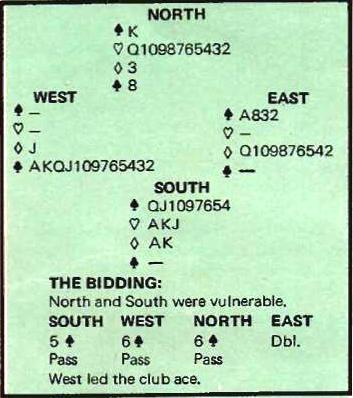
As an example of a five spade opening bid, the South hand in the diagram has three flaws. First, it did not happen—it was dreamed up by the champion Aces. Second, South must gamble that his heart jack will not prove to be a loser. Third, the deal generates typo-graphical panic. Over five spades, West has good reason to bid six clubs, and North demonstrates his theoretical knowledge and bidding discipline by bidding six spades. Whether this contract can always be made, the reader should decide for himself before continuing. A less disciplined North would not resist the temptation to bid his 10-card suit—and would be right. Six hearts would be easy.
East not unnaturally doubles six spades. He has a sure defensive trick, and he wishes to discourage his partner from saving in seven clubs. West, like North, has more discipline than common sense, and passes the double. With a hand worth 12 tricks in attack and nothing in defense he should certainly bid seven clubs. He would make it against a careless lead of the spade king, but North should work out that his partner has top cards in the red suits and lead a diamond.
Against six spades doubled West should perhaps hesitate to lead a club. South is surely void, and there is some danger of conceding a ruff-and-sluff. Luckily for the defense, however, West leads the club ace. He has an informed notion that his partner might over-ruff the dummy, and as a result gives East a unique opportunity to over-ruff the declarer.
Even with four hands in view, most players would fail to find the winning defense as East. But he can do so if he trusts South’s opening bid. South must have eight spades, ace-king in both red suits, and a red jack. On this basis East makes an astonishing play. He ruffs the club ace with the spade ace, and leads a diamond. South finds himself stuck in dummy with the spade king, and East scores a heart ruff to beat the slam. South, who had been regretting his failure to redouble, is understandably dazed at going down in a seemingly certain slam.
He then complains about North’s failure to bid six hearts, and receives a sharp retort. “I was right,” answers North hotly. “When you were doubled you could have retreated to seven hearts. It’s cold from your side.”