




Source: Bridgewinners; 4 Way Transfers with Range Ask
Four-way transfers have been pretty standard among experts for quite a long time. In recent years, experts have found a small tweak which makes it a much more effective system. Rarely, expert tweaks not only make the convention better, but also in fact make them easier.
The major flaw of 4-way transfers as they were taught to me (2 for
for  , 2NT for
  ) was that the trade-off of using 1NT-2NT to show diamonds meant that in order to invite with 8-9 points you now needed to go through Stayman. This caused declarer to unnecessarily reveal information about the majors which in a touch-and-go 2NT or 3NT is not ideal.
The new method removes this by adding a hand type to the 2 club transfer:
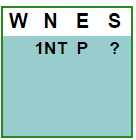
- 2 = 5+
 ,
, - 2 = 5+
- 2 = 6+ OR 8-9 balanced w/o a 4-card major
- 2NT = 6+
I have put in bold the new addition to the method. Let’s discuss the followups to the 2 bid:
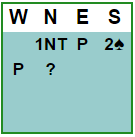
- 2NT = I have a minimum for my range (I would not accept your 8-9 balanced invite)
- 3 = I have a maximum for my range (I would accept your 8-9 balanced invite)
By asking opener to show a minimum or maximum immediately, responder can continue with a transfer auction as before, while at the same time catering to the 8-9 point range. The trade off is that opener can not make a vote on the club suit (expert standard was 2NT I don’t like clubs, 3 I do like clubs).
When responder has 8-9 balanced, the rebid will be quite obvious:
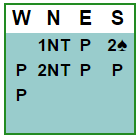
(The old-fashioned auction 1NT-2NT-Pass)
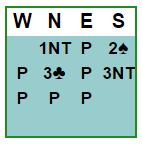
(The old-fashioned auction 1NT-2NT-3NT)
When responder actually has clubs, nothing has changed. All bids continue to mean exactly what they would have meant in the old 4-way transfer structure. Here is a guide for what I play with my partners after opener responds to 2 showing his range:
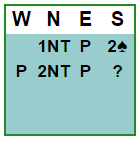
- 3 = 6+, signoff
- 3 = 6+, short , Game Forcing OR 6+, no shortness, with slam interest
- 3 = 6+, short , Game Forcing
- 3 = 6+, short , Game Forcing
All of these responses (except 3, obviously) apply over a 3 rebid by opener as well.
The 3/3 bids showing shortness are standard treatments as we would use Stayman whenever we have a 4-card major and a longer minor. The 3 call is less standard but useful. Opener can bid 3 to ask which hand type it is, and responder can show the unbalanced type with 3 and the balanced type with 3NT.