


Source: ACBL
In our first introduction to bridge, we were all told that each deal has two distinct phases, and that’s how most of us viewed the bidding and play while we were learning. Once the auction was over and play began, we nervously focused our attention on taking tricks, often with no consideration of any bids other than the final one.
With experience, we eventually developed a “bridge memory” and stopped treating the auction as a sepa-rate, forgettable event. For many beginners, it’s an “aha!” moment the first time they use what they learned from the bidding to make a winning decision during the play.
The most successful players also look for opportunities to do that in reverse. They try to predict how the play will go in various contracts, and they use those scenarios to guide their decisions during the bidding.
One of the simplest forms of this exercise occurs when you evaluate your honor holding in an opponent’s suit. If you have the ace-queen of a suit bid on your right, you expect to take two tricks, and that may lead you to choose a more aggressive bid. If that suit was bid on your left, you tend to discount the queen and be more conservative.
The play can also be an important consideration when you have lower honors in an opponent’s suit. Holdings such as J-x-x-x or Q-x-x may be tricks on defense, but of little or no value if your side declares.
Vulnerable against not at matchpoints, what’s your call in this auction?
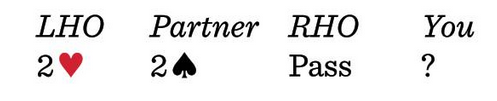
You hold: 
Many players use the “Rule of Seven,” popularized by Mike Lawrence, to make decisions about overcalls and raises after an opponent opens a pre-empt. This guideline recommends that when considering his overcall, partner was entitled to hope for 7 ordinary (not perfect) high-card points in your hand. Because he’s already playing you for this strength, you need at least a good 8 points to justify bidding on.
Nine points with support may seem like more than enough for a raise to 3 4, but a realistic recount should convince you to pass. The  Q is not worth 2 points, and the lack of a ruffing value is another liability. That brings your hand down to 7 points — 6 if you subtract a point for 3-3-3-4 shape — which is no more than partner was hoping for.
If you’re still leaning toward a “courtesy” raise, factor in your best guess about how the play will develop. Add up what you know about the opponents’ hands and try to imagine the play to the first few tricks. The opening lead will surely be a heart, and since RHO’s pass suggests partner has two or three hearts, you could easily lose the first three tricks (to the AKJ or to two high hearts and a ruff or overruff). Even if partner has a heart honor, your queen is unlikely to provide a trick.
Later in the play, you can foresee potential problems in the other three suits. The preempt makes it more likely that trumps will break poorly and minor-suit finesses will lose. Change your hand slightly, though, and you can logically predict a different outcome. If you switch your major-suit holdings to  Q 9 2 and A 6 5, your hand is worth 9 points and a raise because both honors have full value. You know partner can win the heart lead and begin pulling trumps or use the entry to take a finesse. RHO now has a maximum of 6 points in his suit (instead of 8), so he may have a finess-able honor outside hearts. Many other bidding decisions depend on educated guesses about the play. More about these in the next article.