




Source: www.si.com February 15, 1965
 All bidding systems, no matter how complicated are subject to the same code of ethics. They must be a matter of public record, containing no secret bids that mean something to the partners but nothing to the opponent. Of course, this does not mean that a player cannot send a false message—just as a warring power might do upon learning that the enemy had broken its code and was monitoring its broadcasts. In bridge, however, such a procedure is ethical only if there is just as much chance of fooling your partner as your opponents. For this reason most of the deceptive plays in bridge are confined to declarer’s use, since it can hardly matter if the dummy is deceived, whereas a false carding defender must always worry lest his deception do more harm to his own side than to the declarer.
Neither side vulnerable West dealer
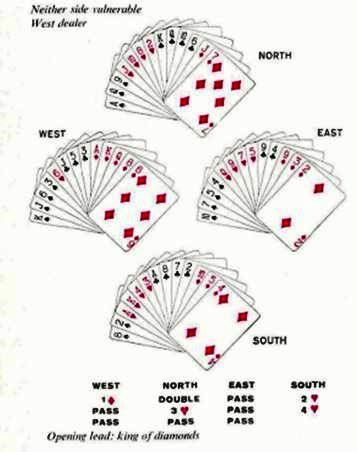
Opening lead:  K
K
Occasionally, however, a situation arises when it cannot matter if partner is deceived: the defender’s only hope is to fool declarer. Such a case is illustrated by this week’s hand, taken front the section on (Awarding in the excellent new Official Encyclopedia of Bridge, prepared by the American Contract Bridge League.
The fate of the hand is decided on the very first trick. If East plays the 2, as his hand calls for, the contract will surely be made. If West continues with two more rounds of diamonds, dummy ruffs low and pulls the jack of hearts through. Whether East covers or not, he will make only one trump trick and the success of the spade finesse allows South to make his contract.
But East should see for himself that this is likely to happen and that his only hope of setting the contract is to con South —and his own partner—into thinking he has two, not three diamonds. So East should play the 9 on the first trick and drop the 2 on the second. Now when West leads the Q (or even if he leads a small one), declarer must be concerned that West began with a six-card diamond suit.
If East indeed has the doubleton diamond that his high-low- signal has announced and should dummy ruff with the 2 or the 8 and get overruffed, declarer will still have to worry about the location of the queen of hearts.
To avoid this problem, what is more natural than to ruff with one of dummy’s honors? Then, if East overruff’s with the queen, declarer will still have three top hearts to draw the rest of the trumps: if East does not follow suit and yet fails to overruff, South can play West for the queen. He will lead to a high heart in his hand and back toward dummy’s remaining honor.
But, as the cards lie, ruffing with one of dummy’s honors is the only way declarer can lose the hand. When East follows to the third diamond, South will realize that he has been jobbed, but there is nothing he can do about it. Holding Q-9-7-5 behind dummy’s remaining J-8-2. East is bound to win two trump tricks and stop the game.
Suppose that East actually held only two diamonds: when North trumped high. East should not overruff. He should discard and play to win two trump tricks, either by force (since West has the all-important 6 of hearts) or by guile if declarer elects to play West for the heart queen and lead low up to dummy’s jack later.