


Source: Mr. Bridge
There are two main reasons why it is much better to check on aces or key cards with 4NT than with 4 . Firstly, whether you are missing two aces should be only one component on a slam hunt, one to do after you have checked other issues, rather than the starting point. Secondly, a bid of 4 so many other possible uses that you cannot afford to sacrifice it for use as an ace enquiry.
On 61% of deals, one side or the other has at least three of the four aces. Obviously, a slam is not available on anything like 61% of deals. Playing double dummy, one side can make a slam about 10% of the time. Probably only half of those slams are biddable, which gives us a biddable slam say 5% of the time. On the other 56%, a slam is either not available or is against the odds. In other words, the vast majority of the time that one side has three or four aces, being in a slam is not sensible. Even if your methods allow you to detect trump honours as well as aces, it is clear that a key card enquiry will rarely tell you positively that you can make a slam.
Before checking on key cards, you want first (a) to establish what denomination you will play in (b) whether you have the playing strength to make twelve tricks and (c) whether you have two fast losers in one suit. For these reasons, it is an advantage to have the ace or key card enquiry at a high level: this gives you more time to check on (a), (b) and (c).
What are the other possible uses for a 4 bid? For everyone, you might want to bid 4 naturally. For anyone who plays cue bids (and you will find it difficult to avoid bidding slams with two top losers in a suit if you do not), you might want to bid 4 as a cue bid. For anyone who plays splinters (and you will find it difficult to bid slams that depend upon fit and ruffing values if you do not), you might want to bid 4 as a splinter. Although I can think of other possible uses of 4, depending upon your methods, let us concentrate on those three.
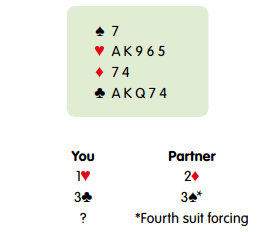
You want to be able to bid a natural 4.
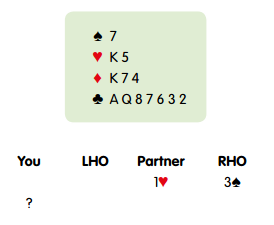 You want to be able to bid a natural 4. You do not want to have to jump to 5. Doing so could take you past the best game if partner has six hearts or give partner a horrible guess whether to raise to 6 if he likes clubs. On the next hand, slam prospects look quite good so long as the opponents cannot cash two diamond tricks.
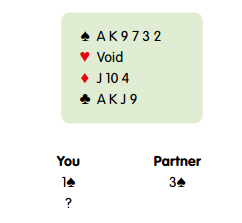
To find out whether they can cash two diamond tricks, you want to cue bid 4, showing the club control and leaving room for partner to bid 4 . You do not want to have to cue bid 4
 and then 5. Doing so could result in one down at the five level if partner unluckily has three losing diamonds.
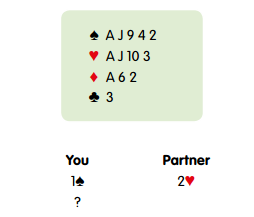 A splinter bid of 4 describes the hand very nicely – a sound raise to 4 with a shortage in clubs. If you cannot bid 4 because it is an asking bid, you have no equivalent way to describe your hand. If you simply bid 4, partner will not know whether you have a flatter hand or maybe a hand like this with the minor suits the other way round. Inventing 3 with a view to raising hearts later is even riskier: if partner raises clubs or gives you preference to spades, it will not even be clear that 4 next time shows support.