


Source: EBU summer-meeting-2015
When I first took up bridge, we were taught something called The Rule of 500. What it said was that if you pre-empted and were left to play there doubled, you should not go for more than -500. In other words, a vulnerable three-level opener should have seven tricks and non-vulnerable six tricks. I don’t think I have ever adhered to such a rigid rule, and I suspect that very few other people have done so either, even back then in the mists of time. But the fact that such an idea could exist and be accepted as standard shows how things have changed over the years. Opening pre-empts today are much looser even for the mass of players, while I believe that they should get even looser, and that is what I see from the younger generation of international and strong tournament players. Let us be clear: the modern trend still takes vulnerability into account, and also position at the table.
At whatever level you pre-empt, you need a better hand, and in particular better suit, when vulnerable, and you should be sounder in second seat than in first or third. That is logical – once one opponent has passed the odds have shifted significantly and there is a much enhanced risk that a random-style opening will pre-empt partner rather than the opposition. But, where most of us were taught that we required seven cards to open at the three level and six at the two level (indeed, the EBU once had a regulation that a weak two opening had to contain at least six cards), that conservative approach is long gone for most strong players. What would you open with these hands, first-in-hand at favourable vulnerability?
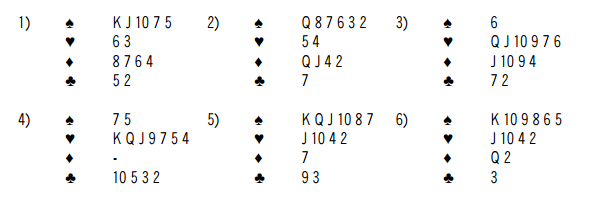
Example 1) is a weak 2 opening for me, though it falls far short of traditional requirements for a weak two opening. I would also open hand 2) with a weak two bid, though the main suit is pretty poor, and example 3) I would open a level higher. The key difference with example 3) is the excellent impletion in the trump suit (impletion is a clever word for stuffing). The hand has decent playing strength, which is added to by the side suit, and absolutely no defence – the perfect time to pre-empt to the maximum. I would open this hand at the two level if vulnerable and would be tempted to do the same with example 2), though I think the weak trumps suggest caution.
Example 4) looks like an obvious 4 opener and I would even be tempted to do this when vulnerable, though 3 might be the wiser choice. Hand 5) and hand 6) go together to illustrate an approach which would have been anathema to the experts of 40 or 50 years ago. I would open 3 (for the same reason as example 3)), and 2 respectively, not worrying about the four-card major side-suit. The point of all this is to pre-empt as often as possible. It makes life tough for the opposition. Yes, it can also be tough for partner should he have the strong hand, but there is one of him and two of them, and we should play the odds. The old rules for pre-empting were based on bridge being a two-handed game – so we wanted to give partner a good idea what our hand looked like, and this was almost more important than doing nasty things to the opposition.
The new rules are that anything goes because we now understand that bridge is a four-handed game. If we cause problems for the opposition far more often than for partner, and perhaps create new opportunities for him along the way, we may pick up some very bad results which could have been avoided by a more conservative approach, but we will assuredly pick up a lot more good results as well. For example, the rule about not having a four-card major on the side was in case we had a fit and a making contract in that suit and to pre-empt would see us lose the fit. But most of the time such a fit does not exist, and on that majority of deals the pre-empt doesn’t hurt our side at all but does put pressure on our opponents.
I think a weak opening is fine when you hold a maximum for the bid and a decent suit, a traditional pre-empt, or whenever you are minimum, whether the suit is good or bad. The time when the odds become poor are when you have a bad suit but a maximum. I have no problem with opening a n on-vulnerable weak two bid on a ten-to-six suit, but only if the whole hand is weak. If there are 9 HCP outside, you risk playing a silly contract, while the chance that the opposition are making something is substantially lower. There are several different schemes of two-level opening in the modern game, and some of those cater to a desire to pre-empt more often.
For example, the Lucas-style two opening allows five-card majors to be opened at the two level as a matter of system so long as there is a second suit on the side (usually a minor). That requires a multi 2 to allow the single-suited weak two bids to be shown. A second possibility, which makes life easier for the pre-empting side, is to play constructive weak twos in the majors, 8-11 or so, and open the bad weak twos, including all those based on five-card suits, in a ‘trash’ multi. It is how you are comfortable handling the five-card major weak hands, and whether you are in love with some other use for the 2 opening, which will decide which scheme you like. Non-vulnerable, the Lucas Twos allow you to open hands containing a weak five-card major with which you would be unhappy to open a simple weak two bid, but hands with a good five-card major can afford to open a simple weak two, with or without a second suit on the side. Is it worth using up the extra bid, 2 multi, to allow you to play Lucas, or is it better to just play loose-style weak two bids and perhaps also a natural weak 2? I must confess to having a soft spot for the weak 2 opener, and have used it on some truly horrible hands, so in several partnerships I just play three natural weak two bids.