


Source: www.omahabridge.org
Too often I have played with partners who assume that when I raise their major suit opening bids, they should just bid a game on suspect values. Well, too bad, but I like to bid too. Never have I promised a rose garden for a one level raise.
Now of course I could try to use “constructive” raises….if I could ever figure out exactly what that means. But the truth is that I’d much prefer partner make some sort of a game try and NOT just jump to game unless he expects to make it opposite a minimum raise.
After responder has raised partner’s opening bid of one of a major suit (e.g. 1 -2 or 1
 -2), there are several methods available that can be used to show extra values and game or slam interest.
METHOD 1. The generally accepted or traditional way has been to use a reraise (1-2-3) to show extra values. The drawback to this method is that it provides little information other than the presence of extra values. Therefore, it doesn’t do much to assist partner in his decision making process. All too often the resulting decision is made by adding the expected high card point count of the two hands together. Secondary fits and duplication of values remain undisclosed.
METHOD 2. A second method is to use a short suit game try–bidding a singleton in a new suit to see how partner’s hand reevaluates with that additional information. This would amount to a sort of self splinter. For example, the auction (with the opponents silent) 1-2-3 would be used to shows shortness in diamonds. This method works very well when shortness exists; however, there are many good hands that do not contain a singleton making this method useless.
METHOD 3. Perhaps the most commonly-used method to make a game try is to bid a new suit: ostensibly one in which help is needed. This method is called a long suit game try or a help suit game try in the USA while in Australia and Europe it is called a trial bid. The long suit game try is an invitation to game in the agreed major suit. (Please don’t pass the game try !)
The suit in which the bid is made usually shows three or more cards and asks for help in this new suit. Generally it should not be made on a minimum opening hand. After 1-2 or 1-2 the opening bidder can make a game try with an invitational hand of about 16-18 points (including points for distribution based on the fact that a fit has been found) or on a hand that has about six losers. In addition, both responder and overcaller can also make a game tries after a fit has been found. Therefore, in auctions such as 1 -1-2/2, 3 and 3 are all available for game try bids. If there are two help suits available, the weaker suit should be chosen, but if the suits are about equal, the game try should be made in the lower of the unbid suits.
When answering long suit game try bids, the following responses should be used:
(1) With no losers in the game try suit, bid game in the agreed major suit.
(2) With one loser in the game try suit, bid game in the agreed major suit.
(3) With two losers in the game try suit, bid game if maximum, but sign off in three of agreed major if minimum.
(4) With three losers in the game try suit, sign off in three of the agreed major suit.
METHOD 4. Sometimes you will find that you’d like to use the short suit game try method (METHOD 2) and at other times the long suit game try method (METHOD 3). It is possible to combine the two methods and play what is called
“two-way game tries.” Using this method, after 1M-2M, 3x shows a short suit game try bid. But going through a relay by using the next suit shows game interest denying shortness and asking reponder to name the cheapest suit in which he would accept a game try. Thus 1 – 2 – 2 denies shortness but asks partner to bid a suit in which he would accept a game try. Similarly 1 – 2 – 2NT asks the same thing.
Regardless of the game try method used occasionally the opening bidder may make what sounds like a game try bid but in actuality is the beginning of a slam try. If responder attempts to sign off and the original game try bidder continues on to game, it confirms that the game try bid was actually a natural slam try bid. Now responder should reevaluate his hand one more time. Similarly, the game try bidder can continue on and try for slam if his partner accepted the trial bid. It turned out to be a slam try!
And, oh yes, reraises showing extra values are out the window in all of the above 3 methods. But, a good use for a reraise is to ask partner to bid a game with good trump support….something like Hxx or any four card support! That way we can stay out of game when we have really bad trump suits.
Try bidding these hands with your favorite partner: (South bids first)
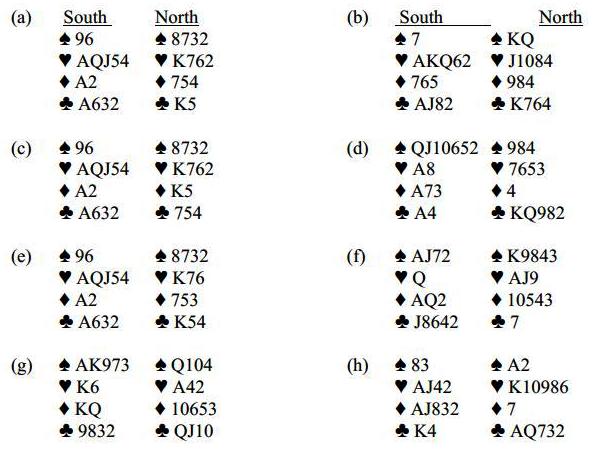 Incidentally, when the opponents are bidding, reraises should always be considered as competitive. While the reraise may seem to imply some extra values, more commonly it simply indicates extra trump length. So, if the auction proceeds (with everybody bidding) 1-2-2-3-3 or 1-2-2-3-P-P-3, the final bid of 3 is not a game try bid. It is always best to keep partner’s confidence by passing these reraises, thus allowing partner’s aggressive bidding style an opportunity to succeed.
With extra values, either in high cards or with distribution, games try bids can still be made in competition if there is “room”. For example, in the auction 1-2-23-3, the final bid of 3 would be a game try. However, sometimes the opponents’ overcalls will interfere with the opener’s ability to make a game try….. as in the auction 1 -2-2-3. In this situation a double can and should be used as a game try. This is called a competitive or maximal overcall double.
The concept of competitive doubles has been expanded to include situations where there is “room” available for some suit bid, but the doubler has a hand that is well suited for defense. When there was “room” in the auction for a game try bid and the bidder doubles instead, it becomes very much a cooperative or competitive double. In essence it asks if partner’s hand is better suited for defense or offense; partner decides by bidding or passing for penalty.
Competitive doubles can also be made by responder as well as the opening bidder. Used this way, a double implies that the doubler is at the top of the range for his previous bid or bids and has good defensive values. In contrast a reraise of the agreed trump suit shows extra trump length and not necessarily extra values.