


Source: wimpy-bridge by Jim Diebel 


When most of us were taught the basics of bidding, we learned that the magic number of combined cards in a suit to make it a desirable trump strain was eight. Toward that end, we raised partner’s 5-card major suit openings holding three card support, but resisted raising partner’s minor suit openings without four or usually five of them. That’s fine advice, and quite sound. From the other side of the table however, it’s my experience that very few beginner and intermediate players will raise responder’s first bid major without four card support. After all, they note, responder will often hold only four of his major (bidding up the line), and raising him will only serve to mislead partner that you’ve unearthed a 4-4 fit when it’s actually only a 4-3. Those players invariably choose to rebid 1NT rather than raise. Many of them play a convention known as New Minor Forcing so that opener can check back for three card support if interested. I even know players who agree to respond 1 over a 1 opening holding as few as two diamonds – just so that they can reserve the response of 1 or 1 to hands where they hold at least five. While this approach might ease opener’s anxiety about raising partner’s major with only 3-card support, it adds an (unnecessary) artificial component to what could be a simple and effective natural bidding system.
Let me be clear about what I’m suggesting here: I think opener should raise partner’s major suit response holding three card support unless he has exactly 3-3-3-4 shape – i.e. whenever he holds a ruffing value in a side suit. Let me illustrate with a few examples: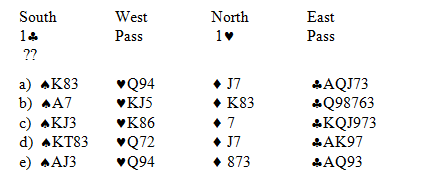
a) 2 If you were thinking about rebidding 2 or 1NT, don’t tell anyone, it will be our secret.
b) 2 Prefer to raise with GOOD 3 card support over rebidding a poor 6 card minor.
c) This one is tricky. At IMP scoring with a good 6 card suit I’d bid 2. At MPs, I prefer 2. Change the K to the A, and I’d jump to 3. Telling partner about a source of tricks is rarely wrong.
d) 1 This is one of the two exceptions to raising. Never bypass a 4 card spade suit to make a 3 card H raise.
e) 1NT Despite holding no diamond stopper, having no ruffing value and only 3 card support, you won’t suggest a heart contract unless partner insists on it later.
This is probably a significantly different approach to the way you usually bid. Since I’m advocating playing in a 4-3 fit occasionally, you might reasonably ask why it’s better than playing 1NT. Sometimes it won’t be. Sometimes No Trump will take the same number of tricks. Sometimes trumps will break 5-1. Still, I expect your results to improve overall with this adjustment. Here is a short list of reasons why raising is better than bidding No Trump:
- Responder will often have a 5 card suit anyway. The times he has a 5 card suit, but is not strong enough to make a game invitational bid using New Minor Forcing, you will be in a 5-3 fit with ruffing value from the short hand. This will usually produce at least one more trick than No Trump.
- If the opponents enter the auction, partner will know you have at least 3 card support. This can be critical in determining whether to bid one more time or defend.
- Occasionally, on stronger hands, you will discover that the partnership has no stopper in a side suit. On these hands, unless you can find a game in a 4-3 major suit fit, it is quite likely that no other game will make.
- In the worst case scenario, you end up in a 4-3 fit on the 2-level. This is rarely a disaster, and solid declarer play technique will, more often than not, produce a superior matchpoint score than 1NT.
- Frequently, the opponents will assume you have found an 8 card fit and balance their way back into the auction. Since you never found an 8-card fit, it’s likely they won’t either. Trouble is, they will often have to go to the 3-level and even then, have no better than a 4-3 fit. I’ve even seen several instances where the opponents balance and end up in 2S in their THREE-THREE fit! Pairs that know how to effectively double can get quite rich.
But those are only the benefits when you raise. When you bid 1NT instead, the inferences can be even more valuable.
- When responder has a 5 card suit and game-going values, he often won’t bother with New Minor Forcing, especially if his pattern is 5-3-3-2. Knowing that partner will not have 3-card support unless he is 3-3-3-4, responder will profitably NOT look for a 5-3 major suit fit, preferring the matchpoint superior contract of 3NT – which will routinely make as many tricks as 4 of the major.
- When the opponents enter the auction after opener has rebid 1NT, you can be relatively certain that partner holds 3 of their suit. If they bid too high, responder can opt for a close penalty double if he holds 2 or 3 of their suit as well.
One exception might be when opener is exactly 2-2-4-5. With 2-2-5-4, I open 1 and rebid 2, but with 2-2-4-5, I open 1 and generally, (if partner responds one of a major and the opponents pass), rebid 1NT. Naturally, if partner responds 1, I raise. Some players prepare for a comfortable rebid by choosing to open those hands with their 4 card diamond suit, but I don’t recommend it. It solves one problem, but creates others.
So now if I’ve convinced you to raise with 3-card support and ruffing value, all that remains is modifying responder’s rebids after the raise:
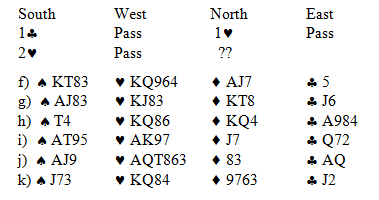
f) 4 You don’t care if partner has three of four hearts. There is no slam, and 4 rates to be better than 3NT.
g) 3NT Partner will correct to 4 if he has four pieces, unless he is exactly 3-4-3-3.
h) 3 This is a cue bid of some sort. Partner will wonder why you didn’t make the cheapest cue bid of 2. Holding the A, partner should bid 3. Holding a slower spade stopper, and only 3 hearts, partner should bid 3NT. With a positional double stop like AQx, partner often will bid 3NT as well.
i) 2 Much like last time, partner’s first responsibility is getting to the right game. Partner should bid 3 with the A or 2NT with a slower diamond stop.
j) 2 Partner may not know it yet, but hearts will be trump. 2 is an advance cue-bid. If partner can cue-bid 3, you are on your way to slam. If he bids something else, (like 2NT, 3NT or 4) you will cue-bid clubs so that he knows you must be looking for a diamond control
k) Pass This is no time to get fancy. You may be in a 4-3 fit. Live with it.
Next… we will examine some techniques on how to play those 4-3 fits for all the matchpoints when you end up there.