




Source: Jim Diebel for  Improve results with a better way to transfer to minor suits after 1NT

This month, I’m going to give you a gift, and it’s not even your birthday! Most players have developed a use for a 2 response after partner opens 1NT. Many use it as some kind of minor suit run out. I’m going to share my treatment and promise that if you adopt it, you’ll improve your results .
When partner opens 1NT (15-17), use 2 as a transfer to clubs, and 2NT as a transfer to diamonds (4-way transfers).
So far, I doubt that you’re excited. Here’s the part that makes it work: When opener holds certain combinations of cards in the suit to which responder is transferring, he conveys a “pre-acceptance” with the next step, i.e., 2NT for clubs and 3 for diamonds. I’m sure a lot of you have seen this before or are already doing it. I doubt, however, that you’ve discussed exactly what is needed for opener to make this call. Most satisfy themselves with the concept of “any high honor.” In practice, this is woefully insufficient.
In fact, what you want is for opener to fill a hole your suit, without using too much of the strength in his hand to do it. More specifically, you would like opener to have either an ace, a king, or length. Over time, I’ve found the ideal holdings to be Ax, Kxx, xxxx, or better. Any of these combinations will generally be adequate for responder to assess the combined values regarding whether to play in a part score, game, or slam.
You hold: Jx  xxx
xxx  KQxxxx xx and partner opens 1NT. You recognize that if partner holds the right hand, 3NT should have great play, and if he holds the wrong hand, 3 will be plenty high enough. You have the tools. Bid 2NT. If partner bids 3, he will play it there. If he bids 3, he either has the A, or perhaps even better, four small ones. Either way, your hand will produce at least five tricks in a 3NT contract.
High cards have very little relevance in these cases. Suppose partner holds 17 points and thinks 3NT is the right contract, but if he can’t pre-accept diamonds, his best holding will be Jxx. The suit will only break 2-2 about 40 percent of the time. Add in another 12.5 percent for a singleton ace in one of his opponents’ hands, and you will realize that 3NT will be a lucky make indeed – and that’s assuming partner had the BEST holding. Other distributions may allow declarer to insure four tricks, but in the meantime, the opponents will have had three shots (counting the opening lead) at establishing their best suit. No way around it, without the diamond ace, or four small diamonds, your chances in game are dicey.
Let’s look at several examples to see how this works: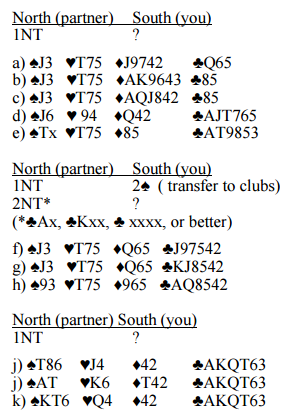 a) Pass There’s little to suggest that 3 will do better than 1NT. Neither is very likely to make.
b) 3NT Wimpy’s Rule #1 states: “Never ask your partner a question when you already know the answer.” If partner holds the Q, your hand will likely produce six tricks. If not, he should duck a diamond and hope for a 3-2 split for five.
c) 3NT Just like the previous problem. Partner might have the K, he might not. He will finesse for it, and if it wins he’ll do it again. If his RHO can duck the 1st diamond lead and win the second, the defense will prevail.
d) 3NT One more time, there are too many combinations that partner won’t pre- accept where you’ll have a great shot at game. If partner has as little as Qx, there will be play for this. He may have better. If he has two small clubs and LHO holding Kxx or Qxx isn’t sharp enough to sacrifice his honor on the first lead of the suit, he’ll still bring in five tricks. Basically, having the tools to find out if partner has the K isn’t necessarily a reason to do it.
e) 2 If partner has Kxx or xxxx, he should be able to bring in that suit. If he has less (likely), 3 will probably be the best place to play the hand.
f) 3. Even if partner has a miracle holding like AKxx, he probably won’t have enough outside strength to hold off the opponents from getting five tricks before he can develop nine of his own.
g) 3NT This one is tricky. If partner has Ax, you will either need some good luck in clubs, or pray that the Q is an entry. Of course, all other holdings where partner pre-accepts gives you a strong chance to pick up at least five club tricks. If you signed off at 3, you are perhaps too timid for this game.
h) 3NT If partner had bid 3 , you would have let him play it there. 3NT would have been too dangerous. With the knowledge that he almost certainly holds the K, you would have to be very unlucky to go down in 3NT.
i) 3NT It’s Wimpy’s Rule #1 again. You are interested in game. You have no interest in slam. Don’t ask a question when you already know the answer!
j) 4 Gerber – Ace asking. It’s unlikely you will settle for less than 6NT. You may even find out enough to be able to bid a grand slam (in no trump, not clubs). Don’t monkey around with a transfer. Take control of this hand and don’t tell the opponents more than they need to know.
k) ?? This one isn’t so clear (yet). If you transfer, partner will virtually never pre- accept. You could easily be off the AK or the AK, so Gerber will have very little value. Clearly you would like to be in slam when partner has the right hand, and play 3NT when he doesn’t. How can you know? I’ll answer that question soon…