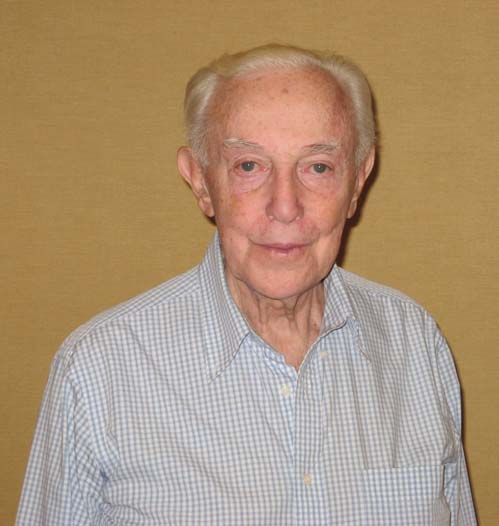
AN HOUR WITH
MARCELO LERNER
By John Carruthers
As
a bit of a bridge historian it is always a
pleasure for me to meet and talk to great
players from earlier days. One such player
is Marcelo Lerner, who won the 1957 South
American Open Team Championship in Chile,
playing for Argentina.
DB: Greetings, Marcelo, please tell us about
your early international bridge experiences.
ML: After we won in Chile in 1957, we were
invited to play in the 1958 Bemuda Bowl in
Lake Como, Italy. In those days, there were
only three teams, and in fact, this was the
first time a non-European or non-American
team played. Europe was represented by the
Blue Team from Italy and the USA had
Crawford-Becker, Roth-Stone and Rapée-Silodor.
Both of those were marvellous
teams.
DB: What about the travel to Italy?
ML: We had two days flying time with
stopovers. We first flew to Recife and from
there across the Atlantic to Dakar. After
Dakar we flew to Madrid then to Rome.
DB: And from there to Como?
ML: We spent a couple of days in Rome
sightseeing, then we took a train to St.
Moritz in Switzerland, where we had been
invited to play in a ‘friendly’ against the
Swiss team and a team from Italy. We won, so
our confidence was high going into the
Bermuda Bowl.
DB: And in the Bermuda Bowl?
ML: We were very unschooled. We played
against the Italian systems, which were all
new to us, this Neapolitan Club and the
Roman Club, without really having any
preparation at all. And those two teams were
the best in the world, so we finished third.
DB: How was the experience?
ML: The bridge was a learning experience.
Everything else was wonderful. For example,
the prize-giving was done by the Prince of
Liechtenstein.
DB: What do you see as the major differences
between then and now at the top level?
ML: Nowadays the young players know much
more than we did then. They are familiar
with all the systems. They still need to
play and practice to gain experience, but
they are much better off than we were in
that regard. Also, in those days, we played
in tuxedos!
DB: What about your later experiences?
ML: I played the 1964 Olympiad in New York
for Argentina, and the 1965 Bermuda Bowl in
Buenos Aires. After that, I did not play too
much internationally because my practice as
a medical doctor took up too much of my
time.
DB: Can you tell us about the famous scandal
from your viewpoint?
ML: We knew nothing at all at the time. When
we played against Great Britain, the Non-Playing
Captain, Ralph Swimer, and the President of
the British Bridge League, Gerald Butler,
were at the table taking notes, but this was
not unusual in any way. Reese and Schapiro
were gentlemen and we did not suspect
anything at all. Later it turned out that
Swimer and Butler had been charting
Reese-Schapiro’s finger signals and when
they compared notes, it turned out that they
could call the number of hearts in the hand
they had not watched when they referred to
the number of fingers displayed.
DB: And what have been your experiences
since then?
ML: I played with Agustin Madala when he was
10 years old! Even then he was a marvellous
player – we played in the Argentine Team
Championship and came second. Last year my
team won the Argentine and South American
Senior Team Championships and competed at
the World Championship in São Paulo.
DB: So you won your first South American
Championship in 1957 and your latest in
2009. Do you have a favourite hand to tell
us about?
ML: I’ll show you a hand from Como. To set
the stage, Jean Besse was kibitzing John
Crawford, the selfconfessed ‘best player in
the world at the time. Since Jean Besse was
actually a candidate for the best player in
the world (with Reese, Schenken, Fourquet
and Belladonna), there was a bit of an
antipathy between the two.
Dealer South. NS Vul.
West
North
East South
John
Carlos
Al
Marcelo
Crawford Cabanne Roth
Lerner
—
—
—
1
1 2
2
5
2
2
5
Pass
Pass
Pass
ML: In those days, our bidding was not so
scientific as it is today. We bid what we
thought we could make. Crawford led the
queen of trumps, and when the dummy came
down, he remarked, “It looks like I made the
best lead.”
Basically, my contract has no play at all,
but I decided to make the best of it. Roth (Crawford
and Roth were not a regular partnership, but
in those days, the Americans mixed their
partnerships quite a bit), followed with the
five of diamonds and I won the king. Perhaps
I could build a spade trick for a heart
discard, so I led the six of spades, four,
queen, seven. A spade to the ace followed
and since my spade play had been so
successful, I tried the queen of clubs;
Crawford played low! What was I supposed to
do; I discarded a heart. I led the ace of
clubs and ruffed a club, then ruffed a spade
back to hand to ruff another club. They were
four-four! Now it was simple matter to lead
a trump, ruff the spade return, draw the
remaining trump and concede a heart. Plus
600!
Crawford was apoplectic. He made all kinds
of excuses: when Roth did not play the
diamond ace, he placed it in my hand; when
Roth did not have the spade ace, he must
have the club ace; Roth raised to two hearts,
so I had no hearts; and so on. Jean Besse,
always a perfect gentleman, simply smiled
softly and nodded.
Jean Besse later wrote a very long article
for the French magazine ”Le Bridge” about
this deal. He was not very complimentary to
Crawford.
DB: Marcelo, thanks very much for your time.
We appreciate it.
Marcelo Lerner, in addition to being a great
player, is a fine gentleman and a very
gracious interview subject. It was a great
pleasure speaking with him.