|
TROMPE-L’ŒIL
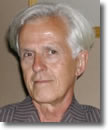
Bernard Marcoux,
Montreal, Bols Award 1996
Trompe-l’œil is
a technique used by painters, aiming essentially at creating,
with artificial perspective, the illusion of real objects.
Basically, it gives the illusion of three dimensions where there
are only two. In Italy, in Liguria, you will find many examples
of trompe-l’œil in churches and temples.
But at bridge, can you create trompe-l’œil
?
Look at this example, from Bob Hamman’s book,
At the table.
Hamman reports this hand played by John
Hancock in 1955 or 56.
Hamman explains also that Sydney Lazard, one
of the great names in American bridge, almost gave up bridge
when he learned how Hancock had played this hand. “How can I
continue to play bridge when there are people making such
brilliant plays?” wondered Lazard.
Hancock opened 1NT and his partner bid 3NT,
over which East hesitated quite a lot before passing, hesitation
noted by everyone present.
Dummy
 6 6
 J54 J54
 A652 A652
 A8765 A8765
West
East
982
AKJ1075
A103
972
KJ1043
87
103
94
Hancock
Q43
KQ86
Q9
KQJ2
Hancock turned towards West and said: “Make
your normal lead.”
Well, West led a spade, the 9.
West had
found declarer’s weakness and East, an excellent player, also
found the right defence when he played the 10, in order to
maintain communication. How could Hancock arrive at 9 tricks
with this perfect start for the defence? He had only 7 tricks
and, the moment he would play heart, opponents would jump on
their Ace and cash all their spades.
So what was Hancock’s play
at trick one?
HE DUCKED !
He knew East could not have the
Ace of heart, for he would have opened with AKJ10xx in spades
and the heart Ace.
If Hancock took his spade Queen, he would go
down for sure. So he had to throw sand in the eyes of the
defenders, he had to use trompe-l’œil in order to create
a false image of his hand for East.
Now, put yourself in East’s place : how can
he think declarer has ducked with Qxx in spades?
The lead of
the spade 9 seemed to come from a doubleton, which would confirm Qxxx in declarer’s hand.
Please note this play can only succeed
against a good player, a player that counts and thinks. A bad
player, seeing his 10 has won the trick, would simply bang down
the Ace and the King, cashing the first 6 tricks and afterwards
telling everyone who would listen how this “expert” ducked a
sure trick and went down 3 in 3NT.
But East was not a bad player and he fell for
the trompe-l’œil created by Hancock.
He saw declarer
would never make a spade trick, after ducking the first trick,
so he switched to a heart. West won and came back another
spade. At trick 3, East won his spade King and, not willing to
give declarer a spade trick, switched again. Hancock had now 9
tricks and it is East who looked like a fool.
But what can one
do in such cases if not congratulate declarer for such a
brilliant play?
At Montreal’s World Championship in 2002, a
player made such a play and it is just too bad we don’t know his
name. Here is his hand and listen carefully to the bidding.
North
J
Q963
J9763
742
West
North East South
1 p 2
p
3
Opening your
hand, in North, at your local game, your level of interest would
probably dip down towards zero because, for the immense majority
of club players, to play bridge is to play the hand.
To play in
defence is a bad moment to endure : it is boring and it is soooooooo long, you don’t pay to be in defence, the only fun at
bridge is to play the hand. If we would make a phone call,
before the start of the game, let’s say to all East-West
players, telling them they would defend 15 out of 24 hands that
night, I think a majority would not come.
Once the bidding
has started like you see, which seems to indicate North-South
are going to slam, you would probably have put your hand on the
table and start yawning.
West
North East South
1 p 2
p
3 p 3 p
4 p 4NT p
6 p 6 p
7
?
3
shows extra values and 6
probably shows a void in diamonds. When West bids 7,
do you think you can do something with your awful hand? The
player seating North in Montreal World Championships, instead of
complaining silently about his bad cards, thought he could do
something. He doubled !!
Follow closely : a double in this
situation is a Lightner double and asks for a special lead. In
this case, the double would probably ask for a lead in the first
suit bid by dummy, spades, and says you will win the first
trick, with a ruff. You cannot ruff the first trick, you say?
I know and that player knew it also, BUT, using trompe-l’œil,
this player created the illusion he was ruffing spades in order
to push the opponents in 7,
which they did. But why did he do that?
Look at the hand
again.
North
J
Q963
J9763
742
Opponents have
established a fit in clubs, North has 3 clubs and maybe, MAYBE,
his partner has a void in clubs and will ruff the first trick.
The double worked perfectly.
West
North East South
1 p 2
p
3 p 3
p
4 p 4NT p
6 p 6
p
7 X!! 7
all pass
The plan had worked, the trompe l’œil had
pushed the opponents in the contract he wanted : the lead was a
club and North waited anxiously, heart pounding, to see his
partner’s first card. Here is the whole deal :
You
J
Q963
J9763
742
West
East
KQ10xx A98x
AJxx Kx
-- K10
QJxx
AK10xx
Part.
xxx
10xx
AQxxx
6
Alas, partner did not ruff (partners are
sooooooooo bad !), but that is not important.
The only
important thing is that this player stayed with the hand during
all the bidding sequence and that he imagined a way to defeat
the grand slam.
I don’t know the name of the player who did
this, but it is, in my view, the most brilliant bid of the year.
What a trompe-l’œil (especially with
bidding boxes !).
|