




Source: February 2014 ACBL Bridge Bulletin 


By choice, I spend most of my bridge hours teaching rather than at the table. Accordingly, I feel I’ve become attuned to the problems advancing players regularly face, and in this new series, I will try to prescribe some cures. Realize how difficult bridge is to learn, no less play well. For instance, in the first few weeks, a beginner is exposed to the meaning of 2 as an artificial opening bid (a) Then comes 2, also artificial, as Stayman (b) Along the way, the newcomer encounters auctions like 1 -Pass-2 (c) Either a traditional two-over-one or in the modern style, at least an opening bid — in both cases, showing a holding of at least four cards. When the opponent opens 1, now a 2 overcall (d) Shows at least five clubs and approximately an opening bid. Still to come, after 1 by an opponent, an artificial 2 overcall. (e) Commonly shows both majors, often less than an opening bid. If the opponent opens 1NT, the overcall 2 (f) Is usually artificial, describing a certain hand-type, depending on which convention is being used. When partner opens 1, the response of 2 (g) may be weak (6-9) or inverted (10+). And then there is 2 (h) in the following sequence: 1 -(Dbl) -Pass-(1); Pass-(2), a cuebid showing great strength without a clear direction.
One could repeat this demonstration with a bid like 3 : Either an opening bid preempt (a); a jump response in a new suit that could be weak, strong or a limit major-suit raise (b); a change of suit response to a weak two-bid, either forcing or not (c); a jump raise, either weak, limit or strong (d); a transfer response to 2NT (e); a support cuebid showing at least a limit raise in a competitive auction (f); a cuebid asking for a notrump stopper (g); or perhaps a mini-splinter after 1 -1 ; 3 (h).
Card play is hardly less confusing for the new player. Let’s say a defender plays the 7. As an opening lead, it could be fourth best, third or fifth best, all from length and strength (a), or it could be top of nothing, especially against notrump (b). When third-hand plays the 7, it could signal attitude (c), count (d) or suit preference (e), depending on the situation.
As well, there is the question of whether the signals are traditional or upside-down. You have probably come to grips with most of these issues, but I suspect you may have other conundrums, and that is what this series proposes to address. Let’s start with how to signal when holding a low doubleton. Assuming standard signals, on lead, you begin with the top card. What about third hand? Decide which card you would play from 84 defending a spade contract.
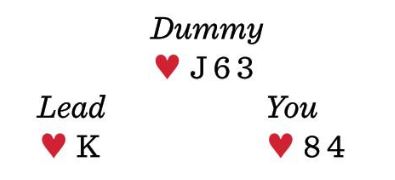
Unless the bidding marks declarer with the A, you should discourage, lest declarer duck with A-x-x-(x). If you lure partner into a heart continuation, a trick is lost.
Same combination, this time you are defending notrump. Which card you play depends on what information the lead of the king requests. If attitude, play a traditional 4; if count, play the 8.
If you don’t know what the lead requests, firm up your partnership agreements. One method: Versus notrump, the ace-lead asks for attitude (memory aid — all “a”) and the king asks for count or unblock (hard “k” sound). Or, you could reverse the meanings. What matters is to have an agreement.
New situation:
 Versus notrump, partner leads low from length and strength. Declarer calls for dummy’s jack. Which card do you play? Give count (a traditional 8 or an upside-down 4). When you can’t beat dummy’s jack or lower, your weak holding is known. An attitude signal becomes redundant, so give count. This may help partner visualize the heart layout and defend effectively. As is apparent, with a low doubleton, there is no such thing as one size fits all. If bridge were that simple, we wouldn’t enjoy its challenges.